
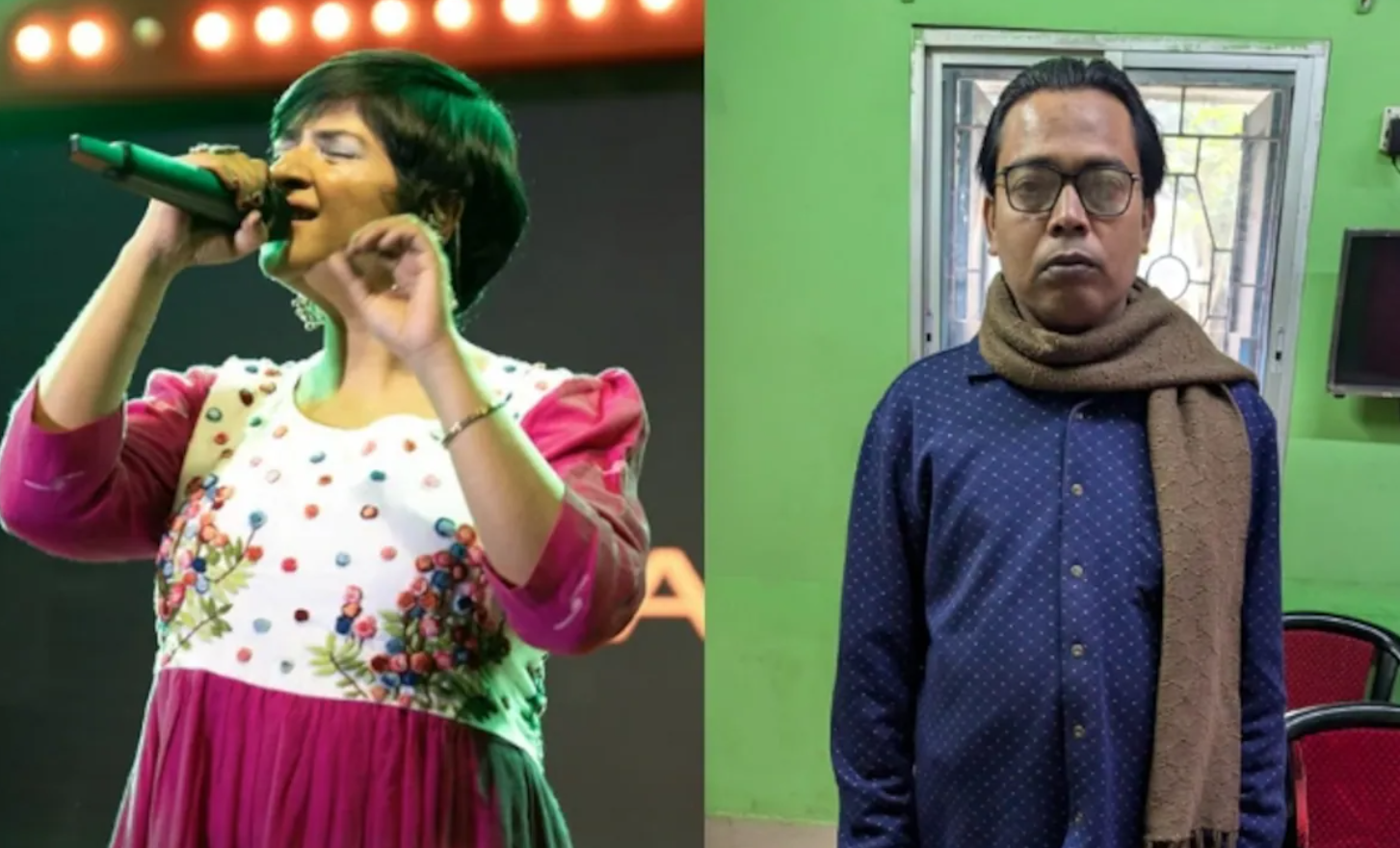
Why Did Lagnajita Chakraborty Have to Be Harassed This Way? Why Was She Ordered to Sing a “Secular” Song? Is West Bengal Turning into an “Extended Bangladesh”?

Why should a singer be humiliated on stage for performing a devotional song? Why should an artist be threatened in public for her choice of music? And who has the authority to decide what is “acceptable” culture and what is not? These uncomfortable questions now confront West Bengal after a shocking incident involving Bengali playback singer Lagnajita Chakraborty, an incident that has shaken not just the cultural world but the social conscience of the state. At first glance, it may appear to be a clash between one singer and one man. But beneath the surface, the incident exposes a far deeper conflict—between freedom and fear, expression and control, faith and selective secularism.
The Incident: A Cultural Evening Turns Into Fear: The incident took place on Saturday evening, December 20, 2025, during a live cultural concert held in Bhagwanpur, Purba Medinipur district, West Bengal. Lagnajita Chakraborty began her performance at around 7:00 PM, as scheduled. The atmosphere was celebratory. The audience listened attentively as she sang song after song. By 7:45 PM, she had already completed seven songs. The eighth song on her playlist was one of her most popular tracks—“Jago Maa”, from the film Devi Chowdhurani.
That is when the evening took a dark and disturbing turn. As Lagnajita began singing Jago Maa, a man from the audience—later identified as Mehboob Mallik—suddenly became aggressive. In full view of the audience, he stormed onto the stage, moved alarmingly close to the singer, raised his hand toward her face in a threatening manner, and shouted: “Enough of Jago Maa. Now sing a secular song.”
For a few terrifying moments, the stage—meant to be a space of art and expression—became a space of intimidation and fear.
Immediate Chaos and Police Action: The performance stopped instantly. Other people present at the venue rushed onto the stage and forcibly removed Mehboob Mallik, preventing the situation from escalating further. The incident occurred at an event organized at South Point Public School, Bhagwanpur.
Later, Purba Medinipur Police arrested Mehboob Mallik, and legal proceedings were initiated against him. However, controversy deepened when reports emerged that there had been a delay in filing the formal FIR. Due to this procedural lapse, a Departmental Inquiry was ordered against the local police. The questions did not stop with the arrest. They multiplied.
Who Is Lagnajita Chakraborty?
To understand the gravity of the incident, one must understand who Lagnajita Chakraborty is.
She is an Indian Bengali playback singer, born in Kolkata, and active in the music industry since 2014. She rose to fame with the song “Boshonto Eshe Geche (Female Version)” from the Bengali thriller Chotushkone. The song earned widespread appreciation from audiences and critics alike.
Lagnajita is primarily known for her work in Bengali films and modern melodic songs. She has also acted in a Bengali film titled “Jodi Bolo Hyan.” She is not known for political statements, provocation, or controversy. She is a professional artist.
Which makes the question unavoidable: why was she targeted at all?
What Is “Jago Maa” Actually About?
At the center of the controversy lies the song “Jago Maa.” But what kind of song is it? Jago Maa is a Bengali devotional song, dedicated to Goddess Durga or Shakti, and deeply rooted in Bengal’s Shakta tradition. The song is a symbolic call to awaken the Mother—to rise against injustice, darkness, and chaos, and to restore strength and righteousness. It is:
- Not a political song
- Not an inciting slogan
- Not a divisive message
In Bengali culture, “Maa” is not merely a religious figure. She represents strength, protection, justice, and moral courage. Songs like Jago Maa are woven into Bengal’s cultural memory, especially during Durga Puja.
In any truly secular society, such a song should stand alongside all other forms of musical expression with equal dignity.
Who Is Mehboob Mallik?
Mehboob Mallik is a local businessman from the Bhagwanpur area of Purba Medinipur. He is known as the co-owner of South Point Public School, where the cultural event was held. Before this incident, he had no significant political or social prominence beyond the local level. It was only after this confrontation that his name entered public discussion across the state. According to the complaint, he verbally abused the singer and attempted to physically intimidate her. Based on these allegations, police arrested him and initiated legal action. Political parties were quick to clarify their positions:
- The Trinamool Congress (TMC) stated that Mehboob Mallik has no organizational or political link with the party.
- The Bharatiya Janata Party (BJP) framed the incident as part of a broader cultural and social crisis.
Political Reactions: Two Opposite Narratives
The incident soon turned into a political flashpoint.
BJP leader Shankudeb Panda alleged: “West Bengal is slowly reaching a point where even the song an artist sings is being dictated. This is an attack on Hindu culture and artistic freedom.” He further warned: “Today it is ‘Jago Maa.’ Tomorrow it could be language, clothing, or thought itself.” On the other hand, TMC leader Kunal Ghosh rejected the BJP’s framing: “The incident is condemnable, but isolated. BJP is trying to damage the state’s image for political gain.” Another TMC leader, Robin Mondal, added: “Dragging the party into this incident is deliberate misinformation. BJP is attempting to inflame public emotions.” Thus, the same incident came to represent two sharply opposing narratives—one of cultural erosion, the other of political exploitation.
Art vs Control: One of the clearest conflicts exposed by this episode is Art vs Control. An artist chooses songs based on creative freedom, emotional connection, and the nature of the event. No audience member has the right to threaten, command, or intimidate an artist on stage. When fear or abuse is used to force an artist to change a song, it becomes a direct attack on artistic freedom. This was not a request. It was coercion.
Devotional vs Secular: A False Opposition
Another disturbing dimension of the incident is the manufactured conflict between Devotional and Secular. In a genuinely secular society:
- Devotional songs are allowed
- Non-devotional songs are allowed
- Artistic choice is respected
Secularism does not mean erasing religious expression. It means equal space for all expressions. Telling someone “Do not sing a devotional song, sing a secular one” is not secularism—it is selective tolerance.
Fear vs Freedom: This incident also highlights a deeper struggle: Fear vs Freedom. When artists begin to fear abuse, humiliation, or physical harm, self-censorship follows. And once fear replaces freedom, creativity dies. Today it is one song. Tomorrow it could be language, dress, belief, or opinion.
“Is West Bengal Becoming an Extended Bangladesh?” — What Does This Question Mean?
This question is not a literal comparison. It is an expression of public anxiety. People fear shrinking space for religious expression, rising intolerance, and forced uniformity. Whether the comparison is accurate or not, the fear itself is real—and fear, when ignored, turns into unrest. This incident is not just about one singer or one song. It represents a clash between:
- Freedom vs Force
- Choice vs Control
- Expression vs Intimidation
A healthy society protects artists, respects diversity, and resolves disagreements through dialogue—not threats. When so-called secular thinking begins to suppress faith, culture, and personal belief, silence becomes surrender. Questioning a devotional song in the name of secularism is not equality—it is selective acceptance.
What is needed today is aware, rational, dignified resistance. A voice not of hatred, but of rights; not of division, but of dignity. Faith and culture can coexist. One does not need to erase the other. The awakening must begin within society itself: “Jago Ma”, “Jago Bangali”, “Jago Hindu”. Not with anger but with reason, courage, and cultural self-respect.
Discover more from News Tap One
Subscribe to get the latest posts sent to your email.
