
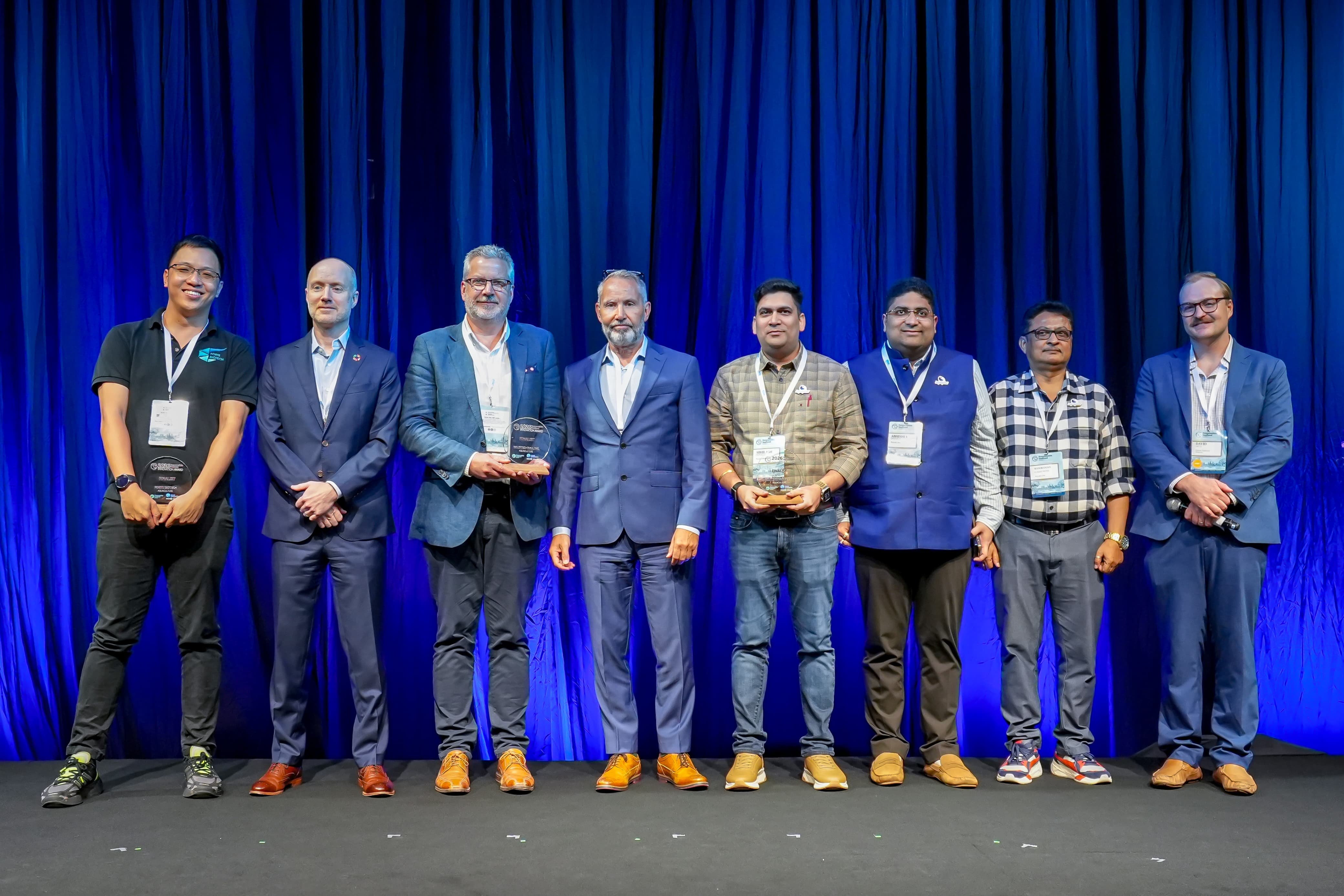
From Odisha’s Shrimp Ponds to Bangkok: Aquapulse Leaves a Global Footprint

The Bhubaneswar-based aquatech startup became a global finalist at the Responsible Seafood Innovation Awards 2026, drawing international attention to its technology-driven approach to shrimp traceability, export readiness and farmer livelihoods.
BHUBANESWAR: Can technology help a small shrimp farmer secure a better price for a harvest while making seafood supply chains more transparent? Odisha-based startup Aquapulse is attempting to address this question, and its approach has earned international recognition.
Founded in 2023, the Bhubaneswar-based aquatech company was named a global finalist in the Aquaculture category of the Responsible Seafood Innovation Awards 2026, organised by the Global Seafood Alliance (GSA). The awards ceremony took place on September 22 at the Shangri-La Hotel in Bangkok, Thailand, as part of the Responsible Seafood Summit.
The recognition places an Odisha startup among innovators working to address some of the seafood industry’s pressing challenges, including supply-chain transparency, responsible production and the economic difficulties faced by smallholder farmers. Aquapulse was a finalist in the competition, although the aquaculture award ultimately went to WildTechDNA.
The challenge behind India’s shrimp industry
India is a major player in the global shrimp export market. However, behind the industry’s international reach are farmers who must navigate fluctuating prices, production risks, disease concerns and the logistical demands of supplying export markets.
For smallholder shrimp farmers, the period leading up to harvest can be particularly challenging. Financial pressure or the threat of disease can force farmers to sell their produce quickly, sometimes at prices below what they might otherwise receive. Inconsistent access to buyers and limited visibility into export-market requirements can further complicate the process.
Aquapulse’s business model seeks to address these challenges by bringing farmers, technology, quality assessment and export management into a connected system.
According to a September 2026 report by the Global Seafood Alliance’s Responsible Seafood Advocate, the startup’s network spans Odisha, Andhra Pradesh and West Bengal and includes more than 6,000 smallholder shrimp farms. Its model is designed to connect shrimp production at the farm level with buyers and processing facilities further along the supply chain.
The objective extends beyond helping shrimp reach export markets. It is also about making the journey of the product more transparent and ensuring that farmers can benefit from meeting the requirements of those markets.
From pond to port: Technology at work
Aquapulse’s award submission highlighted four in-house technology platforms designed to track shrimp through the supply chain, from pond to vessel.
One of the key components is a computer-vision-based application that analyses photographs of ponds before harvesting. The system assesses several parameters associated with pond health and harvest readiness, including water quality and clarity, as well as the condition of feeding and biosecurity infrastructure.
The company also monitors water chemistry throughout the shrimp cultivation cycle, examining factors such as dissolved oxygen, salinity and hardness. These assessments help inform decisions about whether a pond is ready for harvest.
If the required thresholds are not met, harvesting can be held back. This approach aims to align harvest decisions with quality and export-readiness requirements instead of relying solely on timing or immediate market pressure.
Traceability continues after the shrimp leave the pond. The company’s model connects different stages of the supply chain, including processing, allowing buyers to trace the product back to its source.
The system also incorporates logistics and quality checks. According to the Global Seafood Alliance’s report, harvested shrimp are rapidly chilled and transported to processing facilities, where external laboratory testing checks for antibiotic residues.
Together, these processes are intended to improve visibility across the supply chain and help connect farm-level practices with the expectations of international buyers.
When traceability can benefit farmers
Traceability is often discussed in terms of consumer confidence, food safety and the ability of buyers to verify where a product comes from. Aquapulse’s approach places another question at the centre of the discussion: what does traceability mean for the farmer who produces the seafood?
The company links export-readiness assessments with a financial incentive. According to its reported model, farmers whose produce meets the necessary quality requirements can receive payments above the prevailing local market rate on the day of harvest.
This creates a potential link between improved farm practices and better financial returns. Farmers are encouraged to meet quality and biosecurity standards, while buyers gain greater visibility into the origin and handling of their products.
The model does not eliminate every risk associated with shrimp farming, nor does it guarantee higher returns for every farmer. However, it offers an approach in which the commercial benefits of traceability are intended to reach beyond the buyer and processing company.
As Abhilash Dwivedy, Aquapulse’s co-founder and chief growth officer, explained in the company’s award presentation, the aim is to address the imbalance in which farmers bear the cost of traceability while buyers receive much of its benefit.
Building a farmer network beyond technology
A digital platform alone cannot transform an industry in which producers may have different levels of access to technology, training and market information.
Aquapulse has therefore developed a grassroots training programme through which rural youth leaders, referred to by the company as “aquapreneurs”, help farmers understand its processes and adopt its systems.
The company uses a hub-and-spoke model, organising farmers into clusters supported by these local representatives. Training covers the production cycle, harvesting procedures and the operational requirements involved in supplying export markets.
This combination of local engagement and digital assessment is significant because it recognises that technology adoption depends on more than an application or a monitoring system. Farmers also need practical guidance, reliable coordination and a clear understanding of how meeting quality standards can affect the sale of their produce.
The approach connects technological innovation with the people whose work ultimately determines the quality of the seafood entering the supply chain.
Why the global recognition matters
Established in 2012, the Responsible Seafood Innovation Awards recognise individuals and organisations developing solutions to challenges facing the seafood sector. The competition has separate categories for aquaculture and wild-capture fisheries, with three finalists selected in each category.
Aquapulse’s place among the 2026 aquaculture finalists brought international attention to an Indian startup working at the intersection of aquaculture, artificial intelligence, traceability and farmer-focused trade.
The recognition comes at a time when seafood supply chains face growing demands for reliable product information, quality assurance and more responsible production practices. For export-oriented businesses, the ability to demonstrate where seafood originates and how it has been handled can be an important part of meeting buyer expectations.
For India, the wider opportunity lies in combining its established shrimp production and export capabilities with systems that can improve transparency, strengthen quality management and create greater value for producers.
Aquapulse’s model illustrates one way in which technology can be applied to these challenges. Its long-term impact, however, will depend on how effectively it scales its operations, sustains farmer participation and demonstrates measurable improvements in quality, market access and farmer earnings.
The company has also outlined plans to expand its farmer network and develop processing capabilities for ready-to-cook and ready-to-eat products, according to the Global Seafood Alliance’s report.
From the ponds of eastern India to an international seafood industry platform in Bangkok, Aquapulse’s journey highlights a broader question for India’s growing aquaculture ecosystem: can innovation make seafood supply chains not only more efficient and transparent, but also more beneficial to the farmers who sustain them?
The international finalist recognition is an important milestone. The larger test will be whether the model can deliver lasting, measurable value across the supply chain.
Discover more from News Tap One
Subscribe to get the latest posts sent to your email.
