
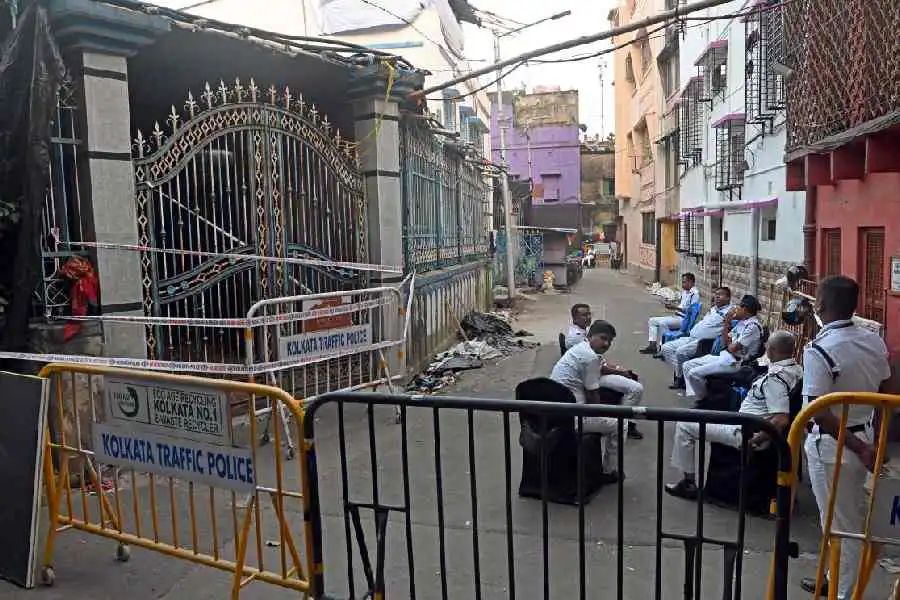
Chorebagan Stampede: Four Days Later, Questions Remain

KOLKATA, October 21: Kolkata’s Durga Puja celebrations took a tragic turn on October 17 when a stampede at the Chorebagan Sarbojanin Durga Puja pandal in north Kolkata claimed 19 lives and left around 25 people injured. What began as an evening of festive celebrations turned into a night of chaos, raising serious questions about crowd management, emergency preparedness and public safety at one of the city’s busiest times of the year.
Four days after the incident, the investigation has brought several aspects of the tragedy into focus. Seven people have been arrested, police have examined CCTV footage and witness accounts, and authorities have initiated reviews of crowd-management arrangements at other prominent Durga Puja pandals. A proposed judicial inquiry is also expected to examine the circumstances surrounding the incident. However, several crucial questions remain unanswered, including whether adequate safety arrangements were in place, how the evacuation unfolded and whether the loss of life could have been prevented.
The incident occurred at approximately 7:40 pm on Saptami, October 17, at the Chorebagan Sarbojanin Durgotsab Samity pandal in north Kolkata. The area was witnessing heavy visitor movement as people continued pandal-hopping during the festive evening. Heavy rain reportedly added to the congestion, with visitors attempting to enter and leave the premises while others sought shelter from the downpour.
According to preliminary findings and accounts reported by news organisations, the narrow approach routes and restricted movement around the pandal contributed to the growing congestion. The situation allegedly deteriorated after an announcement warned visitors that the pandal might collapse and urged them to leave. The warning reportedly triggered panic among people gathered inside and around the premises, resulting in a sudden rush towards the exits.
As people attempted to move out, others were reportedly still trying to enter the area. The resulting pressure created a bottleneck, leaving visitors with limited room to move. Several people fell near the exit, while others were caught in the crowd crush. Emergency services, police personnel, local residents and disaster-management teams subsequently joined the rescue operation. The injured were transported to nearby medical facilities, including Calcutta Medical College and Hospital, while the pandal was closed to visitors and the area secured for investigation.
One of the most significant aspects of the investigation concerns the announcement that reportedly warned of a possible collapse of the pandal. Investigators are examining who authorised the announcement, what prompted the warning and whether it was based on a verified structural concern. Reports have also referred to footage of a public-address announcement instructing people to leave and warning those outside against approaching the pandal.
The circumstances surrounding the announcement are important because public-address systems play a critical role in managing emergencies at crowded events. An evacuation warning must be accompanied by clear instructions, controlled movement and adequate personnel to ensure that people can leave safely. In a densely packed venue, an abrupt instruction to evacuate without a coordinated plan can create conflicting movements and increase pressure at narrow exits. Investigators will need to establish whether the announcement contributed directly to the stampede and whether the organisers and security personnel had a functioning emergency evacuation plan.
Preliminary police findings have also raised concerns about alleged crowd-management failures. Reports have pointed to narrow entry and exit gates, insufficient security deployment and difficulties regulating the movement of visitors. The approach road has also emerged as a significant factor because congestion outside a venue can restrict the movement of people attempting to leave and obstruct access for emergency responders.
These findings raise questions about whether the arrangements were adequate for the number of people expected at the pandal. Were visitor numbers regulated according to the venue’s capacity? Were entry and exit routes clearly separated? Were queues organised to prevent incoming and outgoing crowds from pushing against each other? Were sufficient trained personnel positioned at the points most vulnerable to overcrowding? The answers will be essential to determining whether the tragedy resulted from individual decisions, organisational shortcomings or a combination of failures.
Police have reportedly collected CCTV footage and recorded statements from witnesses and local residents. Investigators are examining the sequence of events, the responsibilities assigned to the people managing the venue and the adequacy of the security arrangements. Forensic personnel have also examined the scene. Although the preliminary findings have highlighted possible lapses, the precise circumstances and criminal responsibility must be established through the investigation.
Seven people have been arrested in connection with the incident. Those named in media reports include Raj Kumar Sewda, secretary of the Chorebagan Sarbojanin Durgotsab Samity; Santanu Dubey, vice-president of the organising committee; Biplab Mukherjee, associated with the construction of the bamboo structure; Koushik Saha and Pintu Dey, identified as crowd-control personnel; and Suman Chakraborty and Rajesh Pal, associated with private security.
The accused were produced before the Chief Judicial Magistrate’s court at Bankshall on October 18 and remanded to ten days of police custody, according to reports. A case was registered in connection with culpable homicide not amounting to murder, with subsequent reporting also referring to provisions concerning attempt to commit culpable homicide and common intention.
The arrests form part of the ongoing investigation and do not, by themselves, establish guilt. Some of the accused have disputed allegations concerning their involvement or pointed to their participation in rescue efforts. Investigators will have to establish the precise responsibilities of those involved, whether safety requirements were followed and whether any specific act or omission contributed to the deaths.
The state government has also announced financial assistance for the families affected by the tragedy. Chief Minister Suvendu Adhikari announced compensation of ₹25 lakh and a government job for the next of kin of each person who died, along with ₹5 lakh for each injured person and coverage of their medical expenses. He also announced plans for an inquiry headed by a sitting judge of the Calcutta High Court, subject to the necessary judicial approval.
The proposed judicial inquiry is expected to examine the circumstances surrounding the incident and identify measures to prevent similar tragedies. Meanwhile, the police investigation is focused on gathering evidence, establishing the sequence of events and determining potential criminal responsibility. The distinction between the two processes is important: financial relief can provide immediate support to affected families, but it cannot substitute for a transparent examination of what went wrong.
The incident has also prompted a review of safety arrangements at other prominent Durga Puja pandals in Kolkata. According to reports published on October 20, senior police officers returned temporarily to strengthen coordination with major puja committees, while organisers were asked to review visitor movement and access arrangements. Measures reported at some venues included widening exits and removing separate VIP rope corridors where these could interfere with the movement of general visitors during a crowd surge. Authorities also reviewed arrangements at prominent pandals, including Tala Prattoy and Santosh Mitra Square.
These steps suggest that the Chorebagan tragedy has prompted a wider reassessment of crowd safety during the festival. However, temporary changes at individual pandals will need to be accompanied by consistent planning and enforcement. Large public gatherings require clearly designated entry and exit routes, appropriate limits on visitor numbers, trained personnel, unobstructed emergency access and coordinated procedures for dealing with sudden rain, structural concerns or other emergencies.
The aftermath has also been marked by controversy over information circulating on social media. Reports published on October 21 said the Chief Minister had alleged that misleading videos and false claims relating to the stampede were being circulated online. The reports also referred to police action against an individual suspected of spreading misinformation. These allegations concern a separate aspect of the incident and should not be confused with the investigation into the causes of the deaths. Claims about the origin of online content and the responsibility of specific individuals require independent verification and appropriate attribution.
The central questions surrounding the stampede remain matters of public interest. Investigators must establish who authorised the evacuation announcement, whether the warning was based on verified information, whether the exits were adequate and whether sufficient personnel were available to control the crowd. They must also examine whether incoming visitors were stopped when the area became dangerously congested and whether a more coordinated emergency response could have prevented the crush.
The tragedy has renewed concerns about the safety arrangements at large public celebrations, where enormous crowds are an expected feature rather than an unforeseen development. Durga Puja attracts millions of visitors to Kolkata every year, making effective crowd management a fundamental responsibility for organisers and authorities alike. Safety planning must account not only for normal visitor movement but also for sudden surges, adverse weather, blocked routes and the possibility of an emergency evacuation.
The most important question is therefore not simply why visitors rushed towards the exit, but whether the arrangements in place were capable of preventing a sudden rush from becoming uncontrollable. Responsibility for public-event safety may be distributed among organisers, contractors, security agencies and public authorities. The investigation must clarify who was responsible for each aspect of crowd management and whether those responsibilities were fulfilled.
Four days after the tragedy, the death toll, arrests and announced relief measures provide an initial picture of the aftermath, but they do not constitute a complete account of the incident. The investigation must establish the facts, identify any preventable failures and ensure that its findings lead to meaningful changes in public safety arrangements.
The tendency to shift the blame onto ordinary people for pandal-hopping raises a more uncomfortable question: should the public be held responsible for turning up to celebrate Durga Puja, or should the administration be held accountable for failing to manage a crowd that was entirely foreseeable? Kolkata’s Durga Puja crowds are neither a new phenomenon nor an unexpected annual occurrence. For decades, the city has witnessed enormous gatherings, traffic congestion, queues stretching across roads and thousands of people moving between popular pandals. The responsibility of the administration is precisely to anticipate these challenges and ensure that public celebrations remain safe.
Reports from Chorebagan have raised concerns about narrow access routes, inadequate police deployment and inexperienced volunteers being left to manage overwhelming crowds. A Telegraph report published on October 21 also quoted puja organisers and visitors expressing concerns about crowd control this year, with some committees reportedly relying heavily on civic volunteers. This puts the new government in a particularly difficult position, given Kolkata’s longstanding reputation for managing Durga Puja crowds through extensive traffic diversions, barricading, police deployment and coordinated crowd-control arrangements. A 2023 Calcutta High Court judgment, cited in subsequent reporting, acknowledged the appreciation Kolkata Police and the administration had received for their law-enforcement and crowd-management measures during the festival.
The comparison with previous years is therefore unavoidable: if the city has repeatedly demonstrated that enormous festive crowds can be managed through careful planning, what went wrong at Chorebagan? The comparison should not become an excuse to romanticise the past or assign political blame without evidence; rather, it should compel the present administration to explain whether adequate personnel, traffic controls and emergency arrangements were in place.
Traffic congestion, meanwhile, is not merely an inconvenience during Puja—it can obstruct ambulances, delay rescue operations and prevent emergency vehicles from reaching densely packed neighbourhoods. The Deshapriya Park incident of 2015 offers a sobering reminder that Kolkata has confronted serious crowd-control warnings before. The rush to see an 88-foot Durga idol overwhelmed the area, brought traffic to a standstill and left 11 people injured, prompting the police to shut the attraction to visitors. That episode demonstrated how publicity, unexpected surges and inadequate preparations can overwhelm even a major festival city. Yet, as reporting on the Chorebagan tragedy has noted, fatal stampedes during Kolkata’s Durga Puja celebrations have been exceptionally rare.
That rarity makes the present tragedy all the more urgent to examine, not a reason to dismiss it as an unfortunate accident. Visitors cannot be expected to regulate a crowd on their own when they have no control over entry gates, traffic diversions, volunteer deployment or evacuation procedures. Nor can civic volunteers, regardless of their dedication, be expected to substitute for trained personnel and a properly coordinated emergency response when thousands of people converge on a narrow stretch of road. The public must follow safety instructions, but the authorities must ensure those instructions are clear, credible and supported by an effective plan. Ultimately, the question is not why Kolkata went pandal-hopping—as it has done for generations—but why a city so experienced in managing Durga Puja crowds witnessed a tragedy of this scale. The answer must come from evidence, transparent investigation and accountability, not from placing the burden of responsibility on the very people who came to celebrate.
For the families who lost loved ones, compensation can offer some financial support, but it cannot undo the loss. What matters now is a transparent investigation, accountability wherever wrongdoing is established and safety measures that extend beyond the immediate aftermath. The lasting measure of the response to the Chorebagan stampede will be whether the questions raised by the tragedy receive clear answers and whether those answers help prevent another such incident at a future public celebration.
Discover more from News Tap One
Subscribe to get the latest posts sent to your email.

