
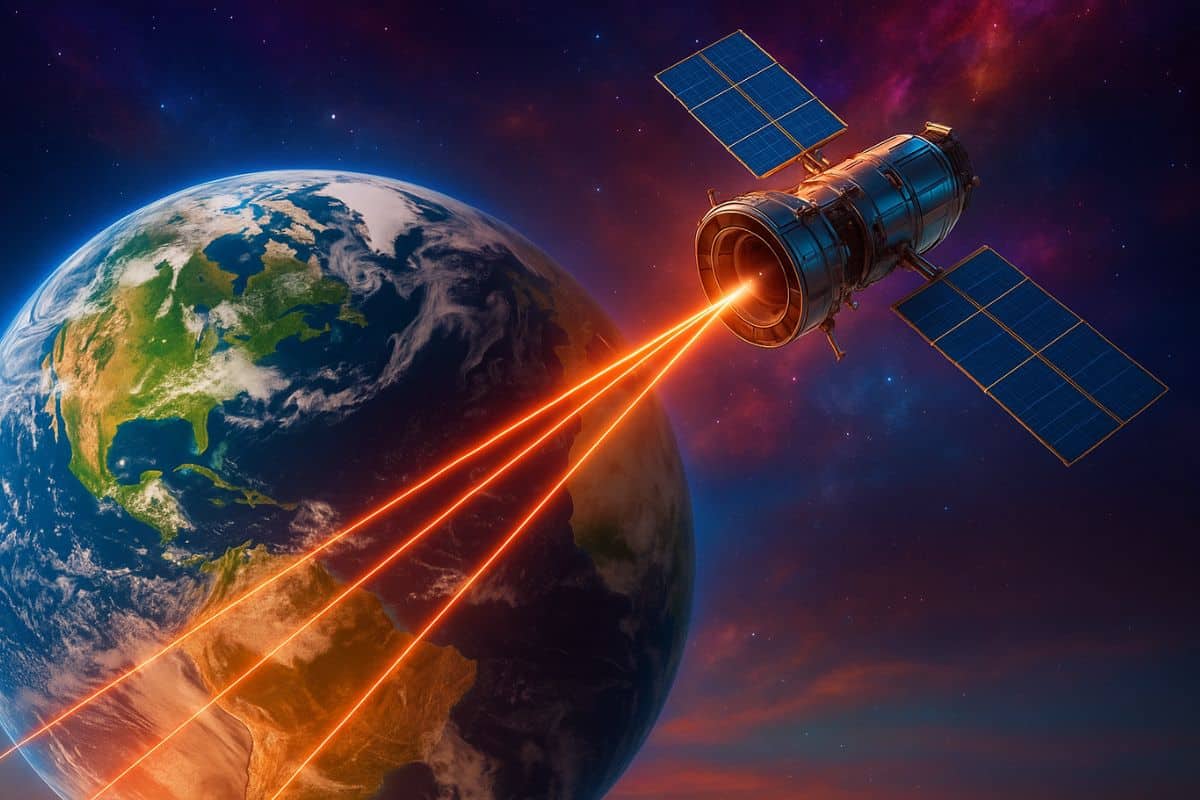
Daytime Lunar Laser Breakthrough Redefines Space Technology.
June 17, 2025 | Beijing, China
In a historic scientific feat, China successfully fired a laser from Earth to the Moon and received a return signal during daylight. This marks the world’s first daytime lunar laser measurement, revolutionizing future deep-space navigation and Moon-based satellite tracking.

Daytime Lunar Laser Test Proves Daylight Precision
China’s Deep Space Exploration Laboratory led the groundbreaking test using a state-of-the-art 1.2-meter infrared telescope located in Tibet. The researchers aimed the laser at Tiandu-1, a lunar satellite approximately 130,000 kilometers from Earth. Despite sunlight scattering and atmospheric interference, the laser pulse was successfully reflected and received. This historic success ushers in a new era of high-precision lunar tracking in daylight conditions, an accomplishment once deemed impossible.
Daytime Lunar Laser Overcomes Harsh Sunlight Barriers
Traditionally, laser-ranging experiments relied on night-time conditions to avoid interference from solar radiation. However, Chinese scientists overcame this long-standing limitation using powerful infrared wavelengths and extremely sensitive photon detectors. These innovations allowed them to isolate the returning signal from background noise. Hence, their technique can now be applied during any time of the day, ensuring uninterrupted observation and analysis.
Daytime Lunar Laser Supports Lunar Research Station Goals
The successful laser test supports China’s broader goal of establishing an International Lunar Research Station by 2030. Consistent tracking of lunar orbiters, regardless of solar interference, enables stable communication links, precise lander navigation, and autonomous surface operations. The ability to monitor satellites at all hours significantly boosts mission safety and coordination.
Daytime Lunar Laser Strengthens Queqiao Satellite Network
China’s Queqiao-2 and its companion satellites—Tiandu-1 and Tiandu-2—form a robust communication and navigation system between the Moon and Earth. The daytime lunar laser test proves these satellites can be located and supported with pinpoint accuracy even during daylight. This capability reinforces the reliability of relay satellites in supporting not only Chinese missions but potential international collaborations.
Daytime Lunar Laser Revolutionizes Global Moon Science and Collaboration
Beyond national goals, this advancement impacts global space science. Accurate distance measurements help model the Moon’s orbit, detect lunar seismic activity, and calibrate instruments across observatories worldwide. Additionally, real-time satellite tracking aids in tectonic studies and refines Earth-Moon gravitational models. With this leap in technology, global researchers can now conduct more consistent and detailed lunar observations.
Daytime Lunar Laser Technology: A Path to Mars and Beyond
This technology’s implications extend beyond the Moon. Future missions to Mars or other celestial bodies will require uninterrupted, precise communication and tracking. Daytime laser ranging can ensure such connectivity regardless of local light conditions. Therefore, China’s success not only benefits lunar science but also paves the way for interplanetary exploration and long-term human presence in space.
Read more : Pluto Climate Discovery Stuns Astronomers.
Discover more from News Tap One
Subscribe to get the latest posts sent to your email.

