
Artemis II Astronauts Return to Earth After Historic 10-Day Moon Mission
In a landmark moment for space exploration, NASA’s Artemis II mission crew safely returned to Earth early Saturday (IST), concluding a 10-day journey around the Moon that is being seen as a turning point in humanity’s return to deep space.
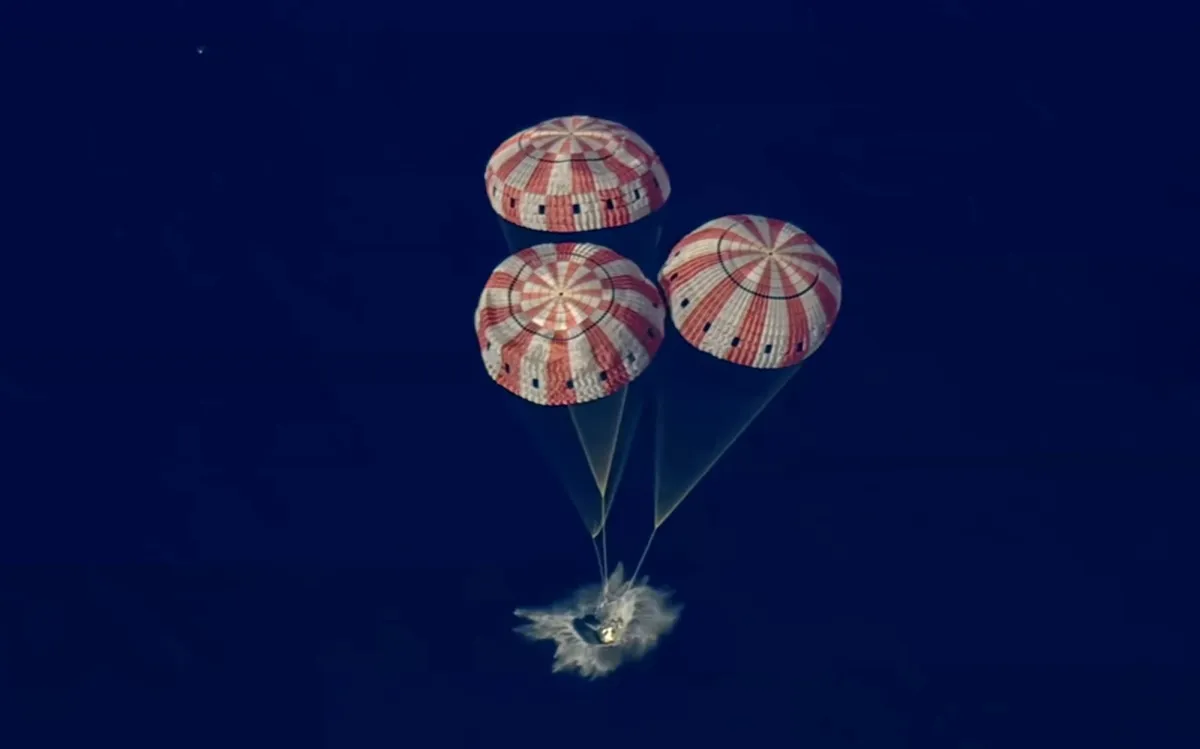
The Orion spacecraft carrying four astronauts splashed down in the Pacific Ocean after a high-speed and high-risk re-entry into Earth’s atmosphere, with recovery teams swiftly moving in to secure the capsule and assist the crew.
Crew Safe After High-Risk Re-Entry
NASA had regained their contact with the astronauts shortly after a brief communications blackout during re-entry, which was an expected phase caused by intense heat building around the spacecraft.
Travelling at speeds exceeding 30 times the speed of sound, the Orion capsule endured extreme temperatures of nearly 2,760°C. The heat shield, which had faced concerns in earlier tests, performed without any issues this time.
Mission commander Reid Wiseman confirmed the crew was “stable” and “green,” indicating they were in excellent condition. NASA officials later reiterated that all four astronauts were safe and doing well.
Alongside Wiseman were pilot Victor Glover, mission specialist Christina Koch, and Canadian astronaut Jeremy Hansen.
The crew is now being transported for routine medical checks before being flown to a US military ship.
First Crewed Lunar Flyby in Over 50 Years
Launched on April 1 from Kennedy Space Center, Artemis II marked the first time in more than five decades that humans travelled around the Moon, a feat last achieved during the Apollo program.
The mission also set a new record, with the astronauts travelling 252,756 miles (406,771 km) from Earth, the farthest distance ever reached by humans.
Over the course of the journey, the crew orbited the Moon, ventured into deep space, and conducted critical system tests designed to support future missions.
Artemis II is widely seen as a crucial test flight for NASA’s long-term lunar plans, including upcoming missions that aim to land astronauts on the Moon and eventually establish a sustained human presence.
Engineers will now analyse data from the mission, focusing on the Orion capsule’s heat shield, navigation systems, and life-support capabilities and all the o essential for carrying humans safely beyond Earth’s orbit.
The successful re-entry, in particular, is being viewed as a major validation milestone.
Discover more from News Tap One
Subscribe to get the latest posts sent to your email.

