
The Manufactured Memory of Martyrs

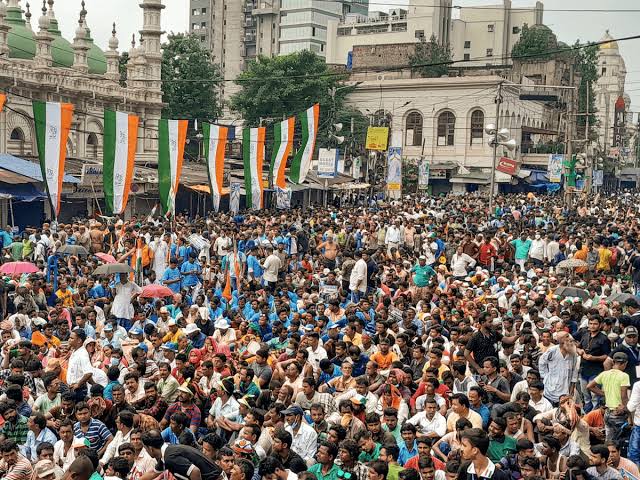
There was a time when Shaheed Diwas rang with the fury of a hurt nation, when its very nomenclature conjured up protests, responsibilities, and defiance. But in the political drama playing out in the streets of Kolkata today – staged with meticulous care, delivered as melodrama, and reproduced with a flimsy flair – that fire remains interred beneath a terrain of performance. The martyrs are no longer mere individuals, they are an abstraction – packaged, written, and called upon at convenience.
The killing of 13 youth Congress workers in 1993 during a protest against the then CPI(M) government was not only a moment of terror – it was a fissure in the illusion of leftist domination in West Bengal. It revealed the savagery that lay behind ideological refinement. For Mamata Banerjee, it was the founding wound – the myth of origin of the All India Trinamool Congress. Ever since 1998, Shaheed Diwas has been an annual renewal of that myth. It has been the emotional investment she’s made time and again, not to question state brutality – but to validate her own monopoly on the narrative of resistance.
Let us not confuse repetition with remembrance. What we see today is not a democratic expression of collective memory, but a ritualised display of political proprietorship. The TMC does not pay respects to the dead so much as it appropriates them – making them eternal loyalists in death, whose heritage is eternally owe to the party that now governs with the same iron fist it earlier criticized.
There is a deliberate irony in this borrowing. The same government which once pledged to demolish authoritarianism has now mastered its tools: violence disguised as administrative action, censorship as cultural stewardship, and street mobilisations identical in mode to the same methods the Left once employed. Shaheed Diwas is, thus, turned into an election campagin, a palimpsest – in which the ink of the struggle has been superseded by the sheen of power.
Today’s rally – enormous, visually dramatic, and emotionally intense – relies very heavily on the politics of identity. Mamata Banerjee is the upholder of Bengali pride against Hindi-heartland aggression. The migrant Bengali worker is the new emblem of marginalisation, subsumed in the grand narrative of regional resistance. But this is not inclusion – it is instrumentalisation. The subaltern becomes noticeable only when their suffering can be used by the optics of resistance. Their actual struggles – poverty, joblessness, political muting – are untouched by the spectacle.
Morever, the opposition is complicit. The BJP, frantically attempting to make an inroad into Bengal, sets off its own rallies, with references to its own dead, weaving its own narratives of grievance. But what both of them have in common is this: a failure to let memory exist independently. Memory has to always be translated into terms through party colour, party flag, party slogans.
In this competition to claim the past, there is no room for self-reflection. The martyrs are never questioned – what they believed in is never questioned. They are instead immortalised in history as idols, denied human agency, sanctified not by truth, but by utility.
This is not grieving. This is manipulation. It is high time we call this for what it is: state-managed memory. It is an imitation of mass mobilisation but one that happens top-down, arranged through party apparatchiks and media projection. The crowd is not a congregation of bereaved citizens – it is a choreographed production of allegiance. The city is not mourning – it is hostage to the state.
Authentic remembrance requires facing the uncomfortable now. It needs to question: what political culture do we presently live in, where death is marketised, where tragedy is ritualised, and where memory of justice is an annual brand initiative? Until we face that question, Shaheed Diwas will continue to be a shadow of itself – not a remembrance but a theatre of power?
Discover more from News Tap One
Subscribe to get the latest posts sent to your email.

