
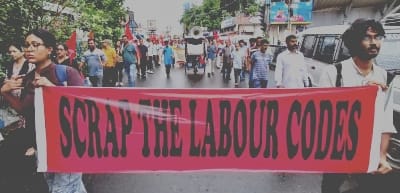
Bharat Bandh Protest Disrupts Banking, Transport, and Mining.
July 9, 2025 | New Delhi, India
Bharat Bandh Halts Key Sectors Across India Over Worker Demands
Massive Nationwide Protest Begins With Widespread Support
On Wednesday, July 9, 2025, over 25 crore workers across India joined the Bharat Bandh protest, demanding urgent policy changes. The 24-hour strike, supported by ten central trade unions, aims to push back against what they call “anti-worker and pro-corporate” reforms.

The strike began before dawn. Protesters gathered outside offices, transport hubs, and highways in several cities. Large parts of the public sector, including banking, insurance, mining, and transport, saw reduced operations.
Union leaders claimed the bandh was essential to protect workers’ rights, job security, and public sector integrity.
Bharat Bandh Protest Hits Banking, Postal, and Transport Sectors
Banking services were hit in several cities, especially those with major public sector branches. While banks remained open technically, staffing was extremely low. Customers faced delays in cheque clearances and withdrawals.
Postal services were nearly suspended in multiple states. Unionized postal workers joined the Bharat Bandh protest, demanding wage clarity and job protection.
Public transport disruptions were visible in cities like Bengaluru, Chennai, and Patna. Buses and metro services operated on thin schedules. In West Bengal and Odisha, state-run ferries were also halted.
Mining operations, particularly in coal belts like Jharkhand and Chhattisgarh, slowed as workers stayed off duty.
Bharat Bandh Protest Based on 17-Point Union Charter
The core of the Bharat Bandh protest revolves around a 17-point demand charter. Trade unions are opposing:
- The four new labour codes passed by Parliament
- Privatization of public sector enterprises
- Removal of minimum wage standards
- The delay in restoring the old pension scheme
- Sale of profit-making PSUs to private bidders
Unions argue that these reforms undermine job security, slash benefits, and erode worker protections.
In response, several states ordered government offices to remain open. West Bengal issued strict compliance orders, warning that absence would be counted as leave without pay.
Despite such directives, turnout for the strike remained high, especially in industrial towns and working-class neighborhoods.
Citywise Impact: Where Services Were Affected Most
In Mumbai, banks and post offices worked with reduced staff, though public transport ran smoothly. Kolkata witnessed minor clashes between workers and Trinamool supporters. Local trains continued after police ensured safety.
Bengaluru faced minor disruption in metro frequency and city buses, but IT companies remained operational. Chennai reported slowdowns on bus routes and short-duration rail delays.
In Patna, the INDIA bloc, including Rahul Gandhi, participated in rallies linking the bandh to broader electoral and wage concerns. Bhubaneswar saw trade union workers block major highways peacefully.
Meanwhile, schools and hospitals remained open in all major cities. Emergency services like ambulances and fire departments continued without interruption.
Public Sentiment Split Between Support and Disruption Fatigue
Citizens across India expressed mixed reactions. Many supported the protest’s intent, especially in towns with major PSU presence. Others criticized the inconvenience caused to daily commuters, pensioners, and small business owners.
Local vendors in metro cities experienced sharp drops in sales. Some private offices allowed remote work to avoid disruption. Meanwhile, social media saw trending hashtags like #BharatBandh and #WorkerRightsNow.
Activist Ravi Awasthi, speaking at a Delhi protest, said:
“This strike is not against development—it is against exploitation in the name of it.”
Bharat Bandh Protest Signals Deep Worker Unrest
The Bharat Bandh protest shows growing unrest among India’s working class. With rising inflation, wage stagnation, and privatization, worker anxiety is intensifying.
Unless the government engages meaningfully, such strikes may become more frequent. Meanwhile, trade unions remain clear—they won’t stand down until the 17-point charter is addressed.
The bandh may end at midnight, but the demands behind it remain firmly on the table.
Read more : Shubman Gill Scores Three Centuries After Sachin Tendulkar’s Advice.
Discover more from News Tap One
Subscribe to get the latest posts sent to your email.


One thought on “Bharat Bandh Protest Disrupts Banking, Transport, and Mining.”