
A Defining Moment in Indo-US Strategic Relations

Vice President Vance’s four-day visit focuses on trade talks, defense cooperation, and cultural diplomacy with Prime Minister Modi.
U.S. Vice President JD Vance began a major four-day official trip to India. The trip, which was accompanied by his wife, Usha Vance, and their three kids, from April 21 to April 24, 2025. It is a significant turning point in India-U.S. relations. Strengthening bilateral cooperation in trade, defence, energy, and cultural exchange was the goal of the visit. Additionally, it coincides with changes in the world economy and a renewed desire to deepen Indo-US strategic cooperation.
Political and Diplomatic Engagements
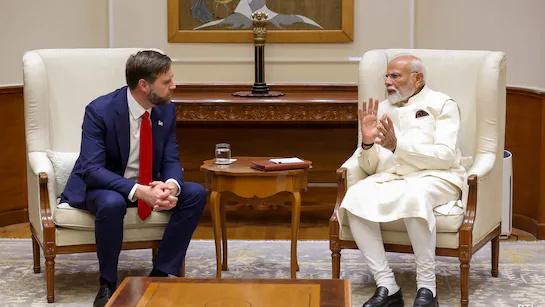
JD Vance met with Indian Prime Minister Narendra Modi during a high-level meeting in New Delhi. Their discussions reinforced the shared visions of the two countries in fostering peace, development, and strategic stability in the Indo-Pacific region.
A major topic of conversation was regional security and the need for defense cooperation. The status of a potential bilateral trade agreement was discussed. Especially since the U.S. recently announced reciprocal tariffs on Indian exports.
Both sides emphasized “dialogue and diplomacy” as the pathway to addressing the global challenges ahead.
Vance acknowledged that Modi is a strong negotiator and called him a “tough negotiator,”. It adds to the foundation of mutual respect that is evolving in the India-U.S. relationship.
Trade and Economic Relationship
The U.S. and India agreed to the terms of reference for an agreement to lower tariff barriers and increase overall trade volume. The goal is to grow India-U.S. trade to $500 billion by 2030.
India sought improved access to American markets, while the U.S. encouraged India to reduce non-tariff barriers. They will up its imports of American goods overall, particularly energy and defense goods. The renewed economic dialogue is a part of a strategic response to President Trump’s suggestion of 26% tariffs on Indian exports, which will be on hold for the next 90 days.
Defense and Energy Cooperation
They discussed India’s desire to purchase U.S. military equipment, particularly the F-35 fighter jets. The two countries had an interest in further collaboration on joint production and technology transfer.
On the energy side, the U.S. was willing to invest in India’s clean and nuclear energy sectors. This matched India’s ambitions to diversify its energy mix and reduce carbon footprint.
Vance pointed out the increasing military interoperability of both countries, stating that the U.S. has conducted more joint military exercises with India than with any other country.
Cultural diplomacy and soft power
Cultural exchange was an important part of the visit. The Vance family visited significant cultural venues, such as Delhi’s Akshardham Temple, Amer Fort in Jaipur, and the Taj Mahal in Agra.
In Jaipur, they were welcomed by Chief Minister Bhajanlal Sharma and Deputy Chief Minister Diya Kumari of Rajasthan.
Prime Minister Modi welcomed the Vance family to his residence and gifted the children presents, while celebrating their son Vivek’s birthday.
These gestures demonstrated that the warm and friendly relationship between India and Canada stemmed well beyond politics and trade.
Future Outlook
JD Vance’s trip to India can be seen as a prelude to President Trump’s expected trip later in the year. It is an important step toward developing a deeper strategic relationship. The results of the trip indicate strong momentum toward a future oriented partnership.
From trade and defense to clean energy and cultural outreach, the Indo-U.S. partnership looks set to be an important narrative in the region and the world.
The tone and content of the trip communicate a shared commitment to develop a robust, multi-dimensional partnership. In the future, it will be able to face all forms of emerging global challenges.
Vice President JD Vance’s trip to India showcased diplomacy, strategic partnership, and cultural diplomacy. It deepened the emerging consensus between two of the world’s largest democracies. It pushed to take a collaborative approach in trade, defense, and global leadership.
Discover more from News Tap One
Subscribe to get the latest posts sent to your email.
