
Direct Action Day 1946: The Tragic Prelude to India’s Partition

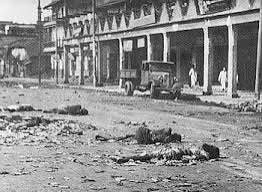
On August 16, 1946, Calcutta witnessed one of the bloodiest communal riots in modern Indian history. What began as a political protest called by the All India Muslim League soon spiraled into uncontrolled violence between Hindus and Muslims. Known as Direct Action Day, it left thousands dead, tens of thousands injured, and marked the beginning of the chain of events that would lead to the Partition of India in 1947.
The day exposed the deep communal divide that had grown under British colonial rule and confirmed that independence would not come without tragedy.
Political Background
The Second World War had weakened the British Empire, and by 1945 it was clear that India’s independence was no longer avoidable. But the shape of that independence remained bitterly contested.
The Indian National Congress, led by Jawaharlal Nehru, Sardar Patel, and Mahatma Gandhi, envisioned a united India. The All India Muslim League, under Muhammad Ali Jinnah, argued that Muslims were a separate nation that deserved their own homeland: Pakistan.
In early 1946, the Cabinet Mission Plan attempted to find a compromise. It proposed a loose federal structure to balance Hindu and Muslim interests. Congress reluctantly accepted, but Jinnah feared it would still lead to Hindu domination. By July 1946, negotiations had collapsed.
Jinnah then announced that the Muslim League would not accept any constitution that did not grant Pakistan. To show the strength of Muslim demand, he called for Direct Action.
The Call for Direct Action
Jinnah declared August 16, 1946, as Direct Action Day. It was meant to be a peaceful hartal (general strike) to demonstrate Muslim League unity. The slogan was clear: “We do not want war, but we are not afraid of it.”
The Muslim League government in Bengal, under Huseyn Shaheed Suhrawardy, supported the call. In Calcutta, a city already divided by religious tension, the announcement created a climate of fear and suspicion.
The Morning of August 16
On the morning of August 16, Muslim League supporters gathered in huge numbers in Calcutta’s Ochterlony Monument (now Shaheed Minar) ground.
Speeches by leaders urged Muslims to show their strength. Crowds shouted pro-Pakistan slogans. Hindu shops were closed as part of the hartal, but resentment grew on both sides.
By noon, clashes began between Hindu and Muslim processions. Stones were thrown, shops looted, and soon violence erupted in the streets.
The Riots Begin
What was supposed to be a show of political strength quickly became a communal bloodbath.
Mobs armed with sticks, knives, and even firearms attacked rival neighborhoods. Hindu and Muslim homes were burned. Entire families were killed in retaliation. Corpses lay in the streets as the violence spread across Calcutta.
The police were unable — or in some cases unwilling — to control the mobs. Many accused Suhrawardy’s Muslim League government of deliberately allowing the violence to continue.
Casualties and Scale of Violence
The riots lasted for nearly four days, from August 16 to August 19, 1946.
Estimates of deaths range from 4,000 to 10,000. Over 100,000 people were left homeless. Hindus and Muslims both suffered heavy losses, though each side blamed the other for initiating the violence.
International newspapers described Calcutta as a city of death. Trains arrived full of refugees, carrying stories of entire neighborhoods wiped out.
Aftermath of the Riots
The Direct Action Day riots changed Indian politics forever.
Trust was broken → Hindus and Muslims who had lived side by side now looked at each other with fear. British helplessness → The colonial administration failed to control the violence, showing they were no longer in control. Strengthening of Partition demand → For Jinnah, the riots proved that Hindus and Muslims could not live together in one nation. Cycle of communal violence → After Calcutta, riots spread to Noakhali, Bihar, Punjab, and elsewhere, setting the stage for the massacres of Partition in 1947.
Political Fallout
The Muslim League argued that the riots showed the impossibility of Hindu-Muslim unity. The Congress blamed Jinnah and Suhrawardy for instigating violence. The British decided that partitioning India might be the only way to avoid full-scale civil war.
In less than a year, India was divided into two nations — India and Pakistan — at the cost of millions of lives and one of the largest mass migrations in history.
Historical Significance
Direct Action Day remains one of the darkest chapters in Indian history. It showed how political rivalry, communal propaganda, and colonial divide-and-rule policies could ignite unimaginable violence.
While independence was a dream realized in 1947, the shadow of Partition — and the memory of Direct Action Day — continues to haunt the subcontinent.
Direct Action Day, August 16, 1946, was not just a protest — it was the moment India’s partition became inevitable. The Calcutta killings exposed how fragile communal relations had become and how political leaders failed to prevent disaster.
Today, remembering Direct Action Day is important not only for understanding history but also for recognizing the dangers of communal hatred, political polarization, and the misuse of mass movements.

“On August 16, 1946, Calcutta witnessed Direct Action Day — a protest called by the Muslim League that turned into communal riots, killing thousands and pushing India toward Partition.”
Discover more from News Tap One
Subscribe to get the latest posts sent to your email.

