
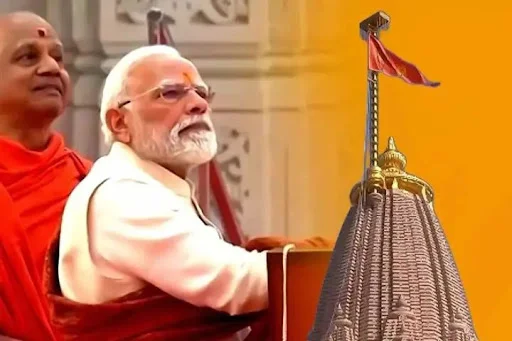
A Historic Day in Ayodhya: The Ram Mandir Dhwajarohan Ceremony

AYODHYA, November 25, 2025 – The holy saffron flag, the Dharma Dhwaj, was hoisted officially on the majestic Shri Ram Janmabhoomi Temple in Ayodhya today, with profound spiritual and national significance, thus marking the official end of the construction of the temple. The ceremony, shot through with centuries of religious belief and ritual, marked the achievement of a long-standing desire of millions of believers all over the globe.
What Happened?
The main ceremony is the Dhwajarohan, and it entails the hoisting of a special saffron flag on the main shikhara of the great temple. This ceremony is one of the most important aspects of the Hindu temple culture, which means the existence of the deity as well as the shift to complete sovereignty of a godly abode in the temple. This flag is about ten feet high and twenty feet long, and it is made in form of a right-angle triangle banner. It has antiquarian images of the Suryavansh (Solar Dynasty) of Lord Rama, i.e. a sun, the sacred character Om, and an image of the Kokidar tree (also known as the Kanchan tree). These identical iconographic elements were present on the royal banners of which there were those that were used by the kings of ancient Ayodhya.

Where Did It Happen?
This event took place on the grounds of the Shri Ram Janmabhoomi Temple Ayodhya, Uttar Pradesh, India. The flag was a 161 foot tower upon which the 42 foot flagpole was mounted; this pole lifted the flag high above the whole complex. Flowers were covering the city, and the security was improved even more due to the large number of thousands of devotees and guests moving in the streets.
When Did It Take Place?
This historical event took place on Tuesday, 25 November 2025. The particular ritual was performed on a very favourable Abhijit Muhurat, at around noon, a time determined with regard to Vivah Panchami, the festival of the divine marriage of Lord Rama and goddess Sita. There was also some spiritual meaning in the day it was also the day of martyrdom of Guru Tegh Bahadur Ji, the ninth Sikh Guru.
Who Was Involved?
The Prime Minister, Narendra Modi, was the lead figure in the main ritual, and hoisted the flag ceremonially. Some of the prominent dignitaries, such as the chief of the Rashtriya Swayamsevak Sangh (RSS) Mohan Bhagwat, the Uttar Pradesh Chief Minister Yogi Adityanath, and Governor Anandiben Patel, were present at his side. The list of the people who came to the meeting was not homogenous and included thousands of invited guests: saints, seers, tribal elders, schoolchildren, and those who had contributed greatly to the movement of Ram Janmabhoomi.
How Was the Ceremony Conducted?
The ceremony was a combination of ancient tradition and modern logistics. PM Modi had been praying at the Saptmandir and the Ram Darbar in the temple complex before the hoisting of the flag. The flag was hoisted with an automatic system in the spire. As the saffron flag was lifted, the saffron mantras of Vedic mantras and temple bells played, PM Modi, becoming choked in emotion, prayed. The live coverage was broad casted to the country. The successful hoisting of the flag was celebrated by all present with happiness and religious zeal and signalled the commencement of a new dawn of cultural celebration and unification of the nation.
Discover more from News Tap One
Subscribe to get the latest posts sent to your email.

