
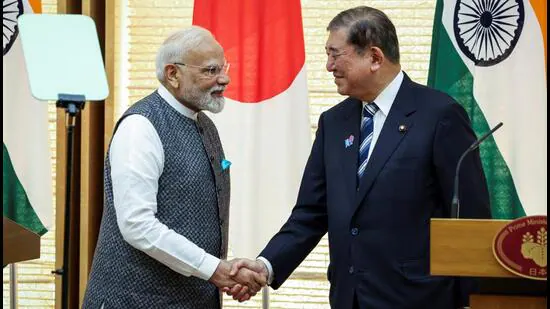
India, Japan to Explore Moon’s South Pole Under Chandrayaan-5
30 August-Kolkata, India: Both India and Japan have signed a collaborative expedition to explore the Moon’s South Pole. Narendra Modi, the Indian Prime Minister, signed the Chandrayaan 5 deal while he was in Tokyo.
The agreement calls for Japan’s Aerospace Exploration Agency and India’s ISRO to collaborate on the joint lunar pole exploration project (LUPEX). India’s ambassador to Japan, Sibi George, and Jaxa’s Vice-President Matsuura Mayumi exchanged the accord.
PM Modi on the space collaboration with Japan
The Indian PM Narendra Modi highlighted on the Chandrayaan 5 deal with Japan and praised his Japanese counterpart Shigeru Ishiba. He said “We welcome the collaboration between Isro and Jaxa for the Chandrayaan-5 mission. Our active participation has gone beyond the limits of the Earth and will become a symbol of mankind’s progress in space.”
The next frontier is to intensify exploration beneath the lunar surface, with a focus on areas that could contain essential resources like water ice, PM Modi said, highlighting the international recognition India received following Chandrayaan-3’s historic 2023 landing near the Moon’s unexplored South Pole.
The Indian PM gave an interview with The Yomiuri Shimbun in which he further added that “Our G2G collaboration in the space sector, between Isro and Jaxa, is fostering a culture of cooperation between our industries and startups. This is creating an ecosystem where innovation flows both ways — from labs to launchpads, and from research to real-world applications.”
About the Chandrayaan 5 mission
The Indian PM approved the mission back in March. As a part of the deal, the mission will carry out an ISRO-made lunar lander, which will transport a Japanese-made rover to the moon, after JAXA launches it aboard its H3-24L launch vehicle.
Along with creating the lander, the ISRO is also helping and contributing various scientific instruments for the mission’s success. The spacecraft will have seven instruments in all, including the neutron spectrometers from NASA and a mass spectrometer from ESA.
Identifying the presence of water on the moon, digging the lunar soil to analyse its water quantity, quality, and composition, and conducting in-situ scientific studies using spectrometers and sensors are the goals of the 100-day mission.
India and Japan to hold meetings
India’s ISRO and Japan’s JAXA held the mission’s third face-to-face technical interface meeting at ISRO’s Bengaluru headquarters on 13- 14 May. The two-day group session brought many senior officials, project managers, and technical specialists from ISRO, JAXA, and Mitsubishi Heavy Industries in Japan.
Key technical interfaces, the joint mission implementation strategy, and potential landing sites were the main topics of discussion. M. Ganesh Pillai, the Scientific Secretary of ISRO, praised the participation of both teams for their future accomplishments and emphasized how important this partnership is to further the mission’s technical and scientific objectives.
Discover more from News Tap One
Subscribe to get the latest posts sent to your email.

