
At Delhi University, Remembering Bhagat Singh Becomes a Battle Over Campus Freedom

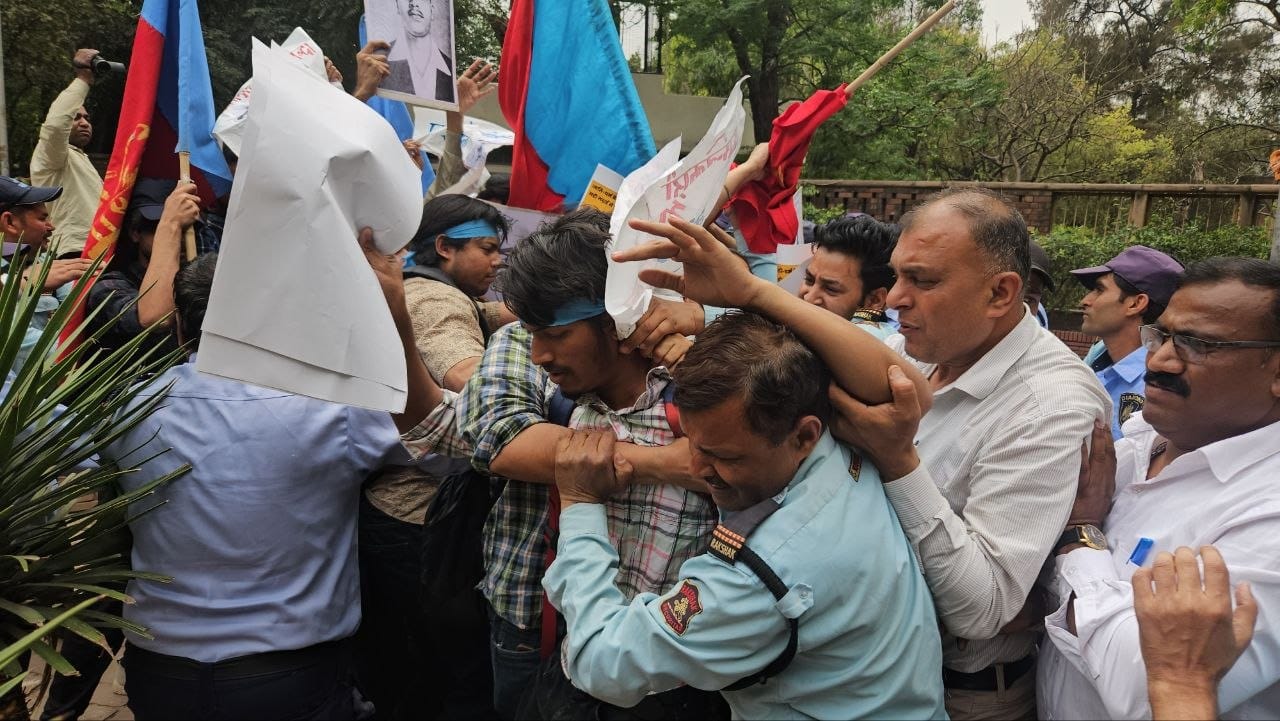
NEW DELHI — What began as a cultural commemoration of India’s most iconic revolutionary martyrs has now snowballed into a wider political flashpoint, with students alleging a forceful disruption of an event remembering Bhagat Singh, Sukhdev and Rajguru at Delhi University’s North Campus.
Student groups claim that on March 27, a programme organised to commemorate the revolutionary legacy of the three freedom fighters was stopped before it could begin. According to participants, authorities intervened at the venue and prevented the cultural gathering from taking place.
The students allege that portraits of Bhagat Singh, Sukhdev and Rajguru were forcibly removed and torn apart during the disruption — an allegation that has since triggered outrage among student communities and intensified debates about democratic freedoms within India’s universities.
The incident has gained further traction after students held a protest demonstration on March 30 at Delhi University’s Gate Number 4, demanding accountability and calling for the withdrawal of recent administrative restrictions governing campus activities.
At the centre of the controversy is a broader regulatory shift within the university. Student groups argue that following the imposition of BNSS Section 163 on campus, the Delhi University administration introduced a new regulation mandating prior permission for virtually any organised activity within university premises — including discussions, cultural programmes and gatherings.
Students say the requirement risks fundamentally altering the nature of campus engagement, where debates, commemorations and discussions have historically formed part of academic and political life.
For many students, the symbolism of the disruption is as significant as the incident itself.
Bhagat Singh, Sukhdev and Rajguru occupy a unique place in India’s political imagination — representing not only resistance to colonial rule, but also intellectual defiance, youth participation in political change, and the idea that dissent can be an instrument of justice.
Student organisers say their programme was intended as a cultural remembrance tied to the martyrdom anniversary of the revolutionaries on March 23, 1931, a date that continues to be marked across India as a moment of reflection on sacrifice and political courage.
Participants allege that the intervention prevented them from conducting readings, discussions and performances intended to explore the continuing relevance of the revolutionaries’ ideas among contemporary youth.
Student speakers at the March 30 protest argued that universities should remain spaces where historical figures can be remembered freely and where ideas associated with justice, equality and democratic participation can be discussed without fear of restriction.
They contend that requiring formal permission for student-led gatherings risks discouraging engagement and limiting the organic exchange of ideas that has traditionally characterised university spaces.
The controversy has also revived debates around the evolving nature of administrative oversight on campuses, particularly in the aftermath of security-related measures that students say are increasingly being extended into academic and cultural spheres.
Students argue that commemorations of national figures should not become subject to procedural barriers that inhibit participation, particularly when such figures are widely regarded as part of India’s shared historical legacy.
As discussions surrounding the incident continue to expand beyond one campus, student groups across institutions are closely watching the developments, viewing the issue as emblematic of a broader tension between regulation and expression within higher education spaces.
For many young people, the incident has come to symbolise a larger question — whether universities will continue to function as arenas for democratic participation, or whether evolving administrative frameworks will redefine the limits of student engagement.
Students involved in the protest maintain that the legacy of Bhagat Singh, Sukhdev and Rajguru belongs not to any institution, but to the people — and that the right to remember figures who shaped India’s freedom struggle remains inseparable from the democratic values those figures came to represent.
As the debate gathers momentum, the events of March 27 and March 30 have ensured that what began as a campus-level disruption is now part of a national conversation on the relationship between youth, memory and democratic space.
Discover more from News Tap One
Subscribe to get the latest posts sent to your email.

