
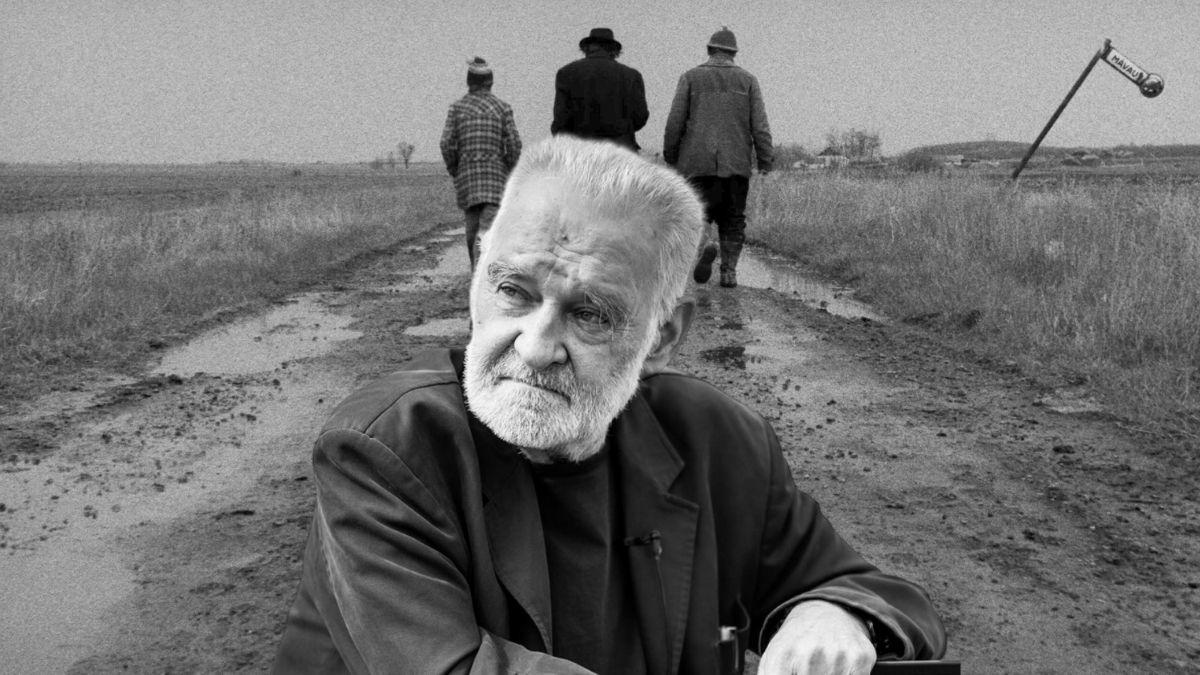
Bela Tarr, philosopher by accident and filmmaker by style,dies at 70.
Credited for capturing the disintegration of socialism in Eastern Europe and pioneering the use of long uncut sequences to transcend space and time, Tarr’s demise has cast a pallor in the hearts of film enthusiasts across the globe.
Sagnik Bhaduri, West Bengal

Photo Credit: MUBI
One of the few existing luminaries of world cinema Bela Tarr(1955-2026) left for his heavenly abode on Tuesday at the age of 70. The Hungarian filmmaker , renowned for his devastating depictions of the human condition through long uncut camera sequences,has had an ever-pervading impact in the sphere of postwar European cinema. A statement from the Hungarian Filmmaker Artists Association confirmed that Tarr had been battling a prolonged illness and that “the grieving family asks for the understanding of the press and the public and that they not be contacted for a statement during these difficult days.”
Mike Downey, producer and outgoing chair of the European Film Academy said: “Cinema has lost one of its real heroes. One of the most exceptional voices of our times has left us. In a time that seems to have forgotten about basic human values, Tarr’s films still stand out magnificently. They remain incredibly relevant and outrageously potent. European cinema will miss him profoundly.”
Bela Tarr:A life
Born in the year 1955 in the city of Pécs,Hungary,to a working class family consisting of a father who was a scene painter and a mother who was a stage prompter.A filmmaker by style and an accidental philosopher, the young Bela had contemplated becoming a philosopher. At the age of sixteen, he started with amateur documentaries exploring urban poverty. In his article (dated October 25,2025) published in The Wire , Ashutosh Bharadwaj praises the jugalbandi (union) between the eminent Nobel-laureate novelist from Hungary László Krasznahorkai which culminated into some of the groundbreaking works in the motion arts.Krasznahorkai’s fine prose ,akin to a string of unpolished jewels, seamlessly juxtaposed with Tarr’s philosophical imagination as the director collaborated with the novelist to adapt his novels “Satantango(1988)” and “The Melancholy of Resistance (2000)”-“Satantango(1994)”,”Werckmeister Harmonies(2000)” alongside “Damnation(1987)” whose script was co-authored by Krasznahorkai.The auteur came to the fore after making “Damnation(1987)” which introduced his forte in crafting uncut sequences by telling a tale about a consuming love affair interlaced with hope,loss and betrayal. Film critic Jonathan Rosenbaum described the work as a “fetish of gloom”. Tarr’s distinctive and realist approach to the celluloid had influenced filmmakers like Gus Van Sant (whose film “Gerry(2002)” was an ode to the master). After his retirement in 2011,Tarr founded the Sarajevo Film Factory in 2013.An eternal iconoclast,he identified as an anarchist and vehemently criticised the resurgence of right-wing nationalism through the rise of figures-USA’s Donald Trump,France’s Marie Le Pen,etc.In December 2023,Tarr signed an open letter in Liberation which criticised the ongoing genocide in Gaza by Netanyahu-led Zionist regime.
Tarr’s films and the poetry of cynicism
Often remembered for introspective masterpieces in black and white like “Damnation(1987)” ,”Satantango(1994)” and Werckmeister Harmonies (2000)”, Tarr was known for his masterful use of long uncut takes ,each of eight or then minutes,which captured the lives of people in the hinges of society or as Judith Butler would term it “the zones of confinement”. Tarr’s magnum -opus “Satantango(1994)” (or the dance of Satan) , which premiered at the Berlin International Film Festival and was a recipient of the Caligari Film Award alongside the FIPRESCI Prize ,is considered to be one of the finest articulation of the cinematic space or mise-en-scene through long take.The film incorporates an episodic narrative and depicts the existential cacophony unfolding in the social lives of the inhabitants of a collective farm located in Hungary. It is set amidst a collective farm on the brink of its existence,its land barren ; a metaphor for the disintegration of socialism in Eastern and with it the public memory of an epoch.The seven-hour epic tells several stories-that of Irimias and Petrina ,two individuals presumed to be dead,returning to the farm. This is followed by a snowball effect into a dark abyss of humanity as a little girl is robbed of her money by heir elder brother and later she ,engulfed by despair, after delivering a painful death to her cat through poisoning it. Through its extended sequences, the film depicts wastepapers being blown towards the direction in which Irimias and Petrina walk;the wastepaper connoting the perils of red tapism. With a Kafkaesque musical score by Mihaly Vig, “Satantango” intertwines philosophical allusions and political commentary to depict an eloquence of oppression amidst an era of political breathlessness.
A profound meditation on time and space ,Bela Tarr’s “Werckmeister Harmonies” follows the arrival of a circus troupe in a small obscure town. An adaptation of Laszlo Krasznahorkai’s novel “The Melancholy of Resistance(1989)”, the film depicts the circus troupe exhibiting the carcass of a whale and one of the members of the troupe(a mysterious character called the Prince;a probable nod to Niccolo Machiavelli) who disrupts the dystopian order of the town with his seditious speeches.The events are narrated from the perspective of a postman names Janos (who works for a musicologist called Gyorgy Eszter). What follows is widespread discontent erupting from the speeches as the authorities attempt to clamp down the voice of the dissident and Eszter being shun away by his wife who was in an affair with the police chief. The whale carcass,which once was seen with awe,now lies decaying away at some corner of the town. Thereby, the whale is profound emblem that acts as the metaphor for the dogma that plagued Communist governments in Eastern Europe,which later transitioned into dictatorships,with the Prince’s character serving the allegory of a dissenter who subverts the temporality of the established regime and the cosmic indifference embodied by totalitarian systems.
The death of the auteur has cast an irrecoverable void in the sphere of Avant garde filmmaking. Tarr’s work continues to be relevant in an increasingly polarised and dystopian world plagued with the death of critical thinking and a surge in doomscrolling. Arjya Shikdar , an avid film enthusiast and an undergraduate student of economics from Vivekananda College said, “Bela Tarr created a movement through his films. The movement, challenged the audiences. His films restrained from using flashy colours, frequent cuts, which is throughout present in his most famous film ,with a duration of seven hours, Satantango . His films were the visual representation of his long-time counterpart, 2025 Nobel Prize winner, Laszlo Krasznahorkai. “
Furthermore he said , “I heard first about Bela Tarr when i was in class 9, i saw my father watching a black and white film, with mind blowing visuals, which turned out to be his last film The Turin Horse. I, personally never had the courage to finish most of his films, but i have seen his Werckmeister Harmonies(2001), which is safe to say, is one of the best films seen by me. His films also challenged the nowadays norm of doomscrolling, by challenging the audience to sit in front of the screen, see those 10-20 mins long one-shot sequences and unravel the magic he wrapped in his films.
Debashish Sen Sharma , eminent filmmaker and theatre academician opined profoundly regarding Tarr’s contribution to the world cinema’s cultural psyche. “Bela Tarr’s primary contribution to world cinema of course will be pioneering the ‘slow cinema’ style with his signature long takes, minimal narrative, and a stark, black-and-white visual aesthetic,all that gives a raw experience of time and space over conventional storytelling,”he said. Furthermore, he fondly recalled his encounter with the master’s work.”His works and scenes focus and emphasis more on atmosphere than giving information.I first got to hear about his works when his films were screened at Kolkata International Film Festival in 2011. We were blown seeing such visuals and narrative on screen.In contemporary times Tarr is more relevant when he shows us a different side of the coin, taking us to a world where information is irrelevant, but essence is important,where carnal experience of audio and visual matters,”said Sharma.
Discover more from News Tap One
Subscribe to get the latest posts sent to your email.

