
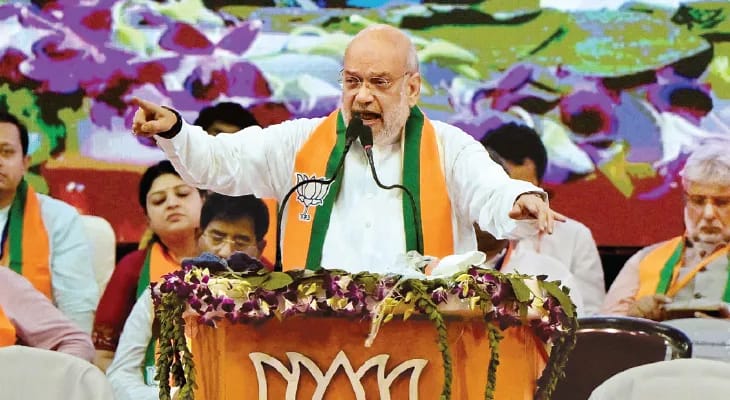
Emergency Lessons India: Shah Urges Youth to Protect Democracy.
June 25, 2025 | New Delhi, India
Amit Shah Reminds Nation of Emergency’s Democratic Cost
Emergency Lessons India: Shah Calls for Public Memory to Remain Active
Union Home Minister Amit Shah, speaking in New Delhi on June 25, called the 1975 Emergency a permanent warning for Indian democracy.
At a youth-focused symposium, he emphasized that only public memory can stop such authoritarian episodes from returning.

He urged Indians to examine not just political speeches but also institutional silence during that dark period.
His remarks came on the 50th anniversary of India’s most significant constitutional crisis.
Emergency Lessons India: Shah Recalls Emergency’s Brutal Measures
Shah listed the specific acts of oppression during the 1975 Emergency.
These included mass arrests, press gagging, judicial curtailment, and unlawful sterilization drives.
Over 100,000 citizens were detained without trial under the Maintenance of Internal Security Act.
The Home Minister stressed that even judges lost freedom, with constitutional safeguards suspended within hours of Emergency’s declaration.
He said, “The constitution took years to draft but was dismantled in minutes by personal interest.”
He further highlighted that the very idea of checks and balances disappeared for 21 months.
Basic rights such as free speech and legal defense stood nullified.
Congress Allies Under Fire for Past Complicity
The minister questioned why parties like the DMK and SP, once part of Emergency enforcements, now speak of constitutional values.
He remarked that many leaders currently vocal about freedom had remained silent in 1975.
He said, “Those jailed then fought for India. But those who cooperated should not rewrite history as heroes today.”
The remark aimed directly at opposition parties currently allied with Congress.
Shah noted that the Emergency was not just a political mistake but a systemic failure at all levels.
Police, civil services, media, and even judiciary members either supported or submitted to authoritarian control.
He cautioned that institutional obedience, when unchecked, becomes a dangerous weapon in the hands of the powerful.
Emergency Lessons India: Youth Urged to Read Historical Documents
Shah strongly recommended that today’s students read the Shah Commission report and Jayaprakash Narayan’s “Sampoorna Kranti” appeal.
He said those documents show the collapse of law under unchecked executive power.
He added, “It’s not enough to vote every five years; we must understand what happens between elections.”
The Emergency, he said, wasn’t only a political action—it was a betrayal of public trust.
He also requested schools and colleges to include the Emergency as a compulsory subject in political science curricula.
This, he claimed, would give the younger generation tools to question propaganda and resist blind allegiance.
Teachers, he said, must connect past lessons to current political events without bias.
Judiciary and Media Should Remain Independent
The Home Minister reminded the audience that the judiciary and media must maintain independence during times of political tension.
He criticized those who mock judicial activism but praised Emergency-era court silence.
He said press houses that now boast of independence once accepted government directives without question.
“The fourth estate must never be the fourth ministry,” he stated firmly.
He proposed building a permanent public archive of Emergency materials, open to journalists, students, and historians.
This archive would document stories of resistance, interviews with detainees, and legal records.
It would also serve as a transparent warning for future generations about the cost of democratic failure.
Civil Society’s Role in Upholding Democratic Vigilance
Shah emphasized that defending democracy does not rest only with governments.
Civil society must ask questions, challenge policies, and protect free institutions.
He called on NGOs, media outlets, and public intellectuals to take neutral positions and never align blindly with ruling or opposition forces.
He argued that democracy thrives when dissent is constructive and organized.
Concluding his address, Shah said the Emergency proved that no one—no matter how powerful—should escape scrutiny. According to him, only constant public vigilance can safeguard democracy. Citizens, he stressed, must stay alert to early signs of authoritarianism.
Citizens, he said, must remain alert to subtle signs of authoritarianism: fear-driven silence, data suppression, and judiciary bypasses.
A Call for Institutional Resilience
The Home Minister also touched upon electoral reforms, saying voter awareness alone cannot protect institutions.
He urged Election Commission reforms, digital transparency, and real-time voter education as urgent national priorities.
He said, “We need institutions stronger than individuals. That’s how democracies outlive demagogues.”
He reiterated the importance of celebrating resistance and remembering the courage of those imprisoned in 1975.
Emergency Lessons India: A National Reminder
Shah closed by suggesting that India mark June 25 as Democracy Protection Day.
He believes the country must not forget that its Constitution was once suspended and that justice disappeared overnight.
By keeping Emergency lessons India alive, he said, the country honors its past and secures its future.
He ended with the line, “When memory fades, tyranny returns. Let’s never forget that.”
Read more : Kashmiri Man Paraded: Theft Accused Humiliated on Police Jeep in Jammu.
Discover more from News Tap One
Subscribe to get the latest posts sent to your email.

