
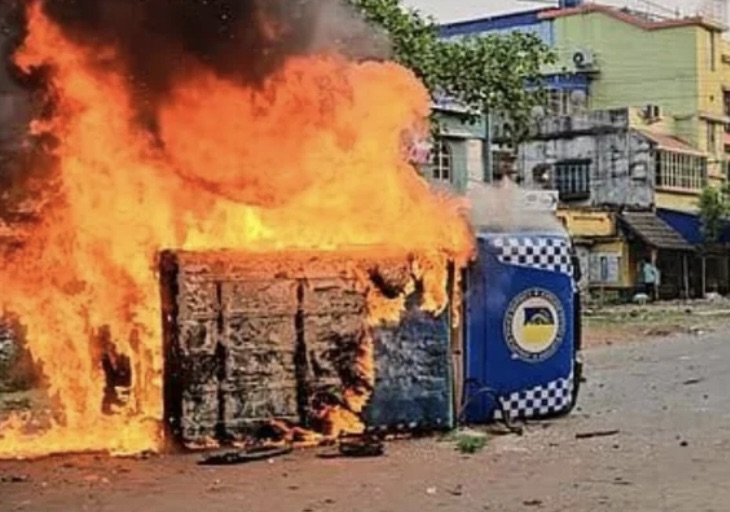
Murshidabad Protests, father and son pronounced dead; is Bengal burning?
What began as a series of protests against the recently passed Waqf (Amendment) Bill quickly spiraled into violent clashes in West Bengal’s Murshidabad district. The unrest resulted in three deaths, injuries to 15 police personnel, and the arrest of 118 individuals. The situation escalated so rapidly that the Calcutta High Court ordered the deployment of central forces in the region until Thursday to maintain law and order.
Chief Minister Mamata Banerjee, in an appeal for peace, urged citizens to refrain from engaging in what she called “non-religious activity in the name of religion.” She also clarified the state government’s stance, stating that the amended Waqf law would not be implemented in West Bengal.
The protests initially started as peaceful demonstrations in various districts shortly after the Bill’s passage in Parliament. However, they quickly turned violent. According to police reports, one of the deceased died from bullet injuries sustained at Sajurmore crossing, though his identity remains unknown. In a particularly horrific incident in Samserganj, a father and son—Hargobindo Das (72) and Chandan Das (40)—were allegedly hacked to death by unidentified miscreants.
The violence continued into the next day, with fresh clashes reported from Shamsherganj on Saturday morning. A heavy contingent of state police and BSF personnel has since been deployed in the affected areas. Prohibitory orders have been imposed and internet services suspended in several pockets of Murshidabad to prevent further escalation.
State Director General of Police Rajeev Kumar, addressing the media from Bhawani Bhawan, stated:
“We will not tolerate hooliganism. We will deal with it very, very strongly… Police use minimum force. But I want to make it clear – wherever it takes, we will deal with the situation strongly.”
He further explained the progression of events:
“It started as demonstrations, then public property was damaged, and then it took a communal angle. Last night, we controlled the situation. In the morning, a fresh flare-up took place, and we again controlled the situation. We are not action-shy. If miscreants take the law into their hands, we will act very, very strongly.”
Kumar also warned citizens against misinformation:
“Strong action will be taken against people who spread rumours. I appeal to everyone not to spread rumours.”
On Saturday, Chief Minister Banerjee posted on X:
“I appeal to all religions, please remain calm and restrained. In the name of religion, don’t do any non-religious activity. Every person’s life is important… for political reasons, don’t instigate riots. Those who are rioting are basically harming the society. You should remember… the Central government introduced that law. So, if you want to ask, ask the Centre… We already specified our stance that we do not support such a law. We will not implement this law in our state. Then, why are you rioting?… Whoever is instigating riots, we will take stern action against them. We will not tolerate any violence.”
However, political tensions remain high. BJP MLA Suvendu Adhikari, the Leader of the Opposition in the West Bengal Assembly, strongly criticized the state government, saying:
“There is an attempt to change West Bengal to West Bangladesh. Mamata Banerjee should resign. The police is not acting. That is why Calcutta High Court ordered deployment of central forces.”
Amidst the chaos and politicization of the issue, NewsTapOne aims to offer clarity on the Waqf Amendment Act itself.
Contrary to much of the misinformation circulating online, the Act does not revoke any rights of minority communities. The protests appear to stem from a combination of misinformation, fear, and political manipulation. To understand the amendment, it’s important to distinguish between the Waqf Board and Waqf property.
The key change introduced in this amendment is the right of individuals to appeal Waqf Tribunal decisions in a court of law—something that was previously not possible. There is no clause in the Bill that permits the government or any authority to seize mosques or other religious structures.
In fact, the provision strengthens public accountability. It allows members of any community to challenge potentially exploitative or unjust decisions made by Waqf authorities. In the past, there have been numerous cases where Waqf land was allegedly handed over to affluent individuals for commercial gain rather than being used for the welfare of the Muslim community. The absence of an appellate mechanism meant there was no way to contest such decisions—until now.

