
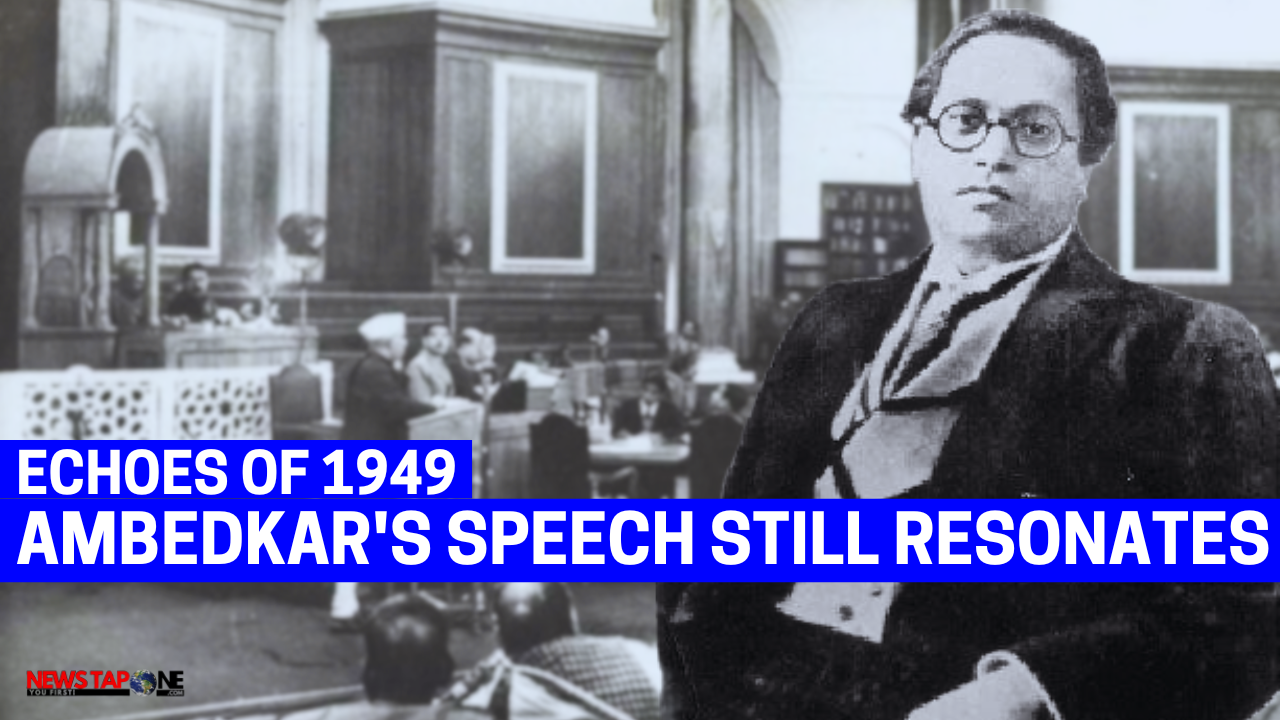
The Relevance of Ambedkar’s Constitutional Defence in Today’s Divided India
In the hallowed halls of the Constituent Assembly, on November 25, 1949, as India stood on the threshold of a new dawn, Dr. B.R. Ambedkar gave a speech that was as much rejoicing as it was cautioning:.
He spent decades working for the drafting of a Constitution that would lay the foundations for a democratic, egalitarian, and united India. But even at that moment of triumph, the words of Ambedkar betrayed some apprehension-a sense that the success of that seminal document was far from guaranteed.
Ambedkar’s speech, which is remembered by most yet perhaps followed by few, contained in it a number of warnings concerning the dangers which were to assail India’s democracy. He was to prove prophetic in the growth of dividing politics, the tempting allure of hero-worship, and the fragile character of democratic institutions. As we confront the problems of India in the 21st century, his reflections are particularly noteworthy.
Why the Constitution Was Condemned: A Battle of Ideologies
One of the most striking features of Ambedkar’s speech was the response he gave to early criticism of the Constitution. He mentioned that the severest critics were from the Communist and Socialist parties. This, he said, was not because the Constitution had serious flaws but because the Constitution did not conform to their ideals.
The Constitution was opposed by the Communists because it supported parliamentary democracy, instead of a government led by workers. The Socialists were upset by the limitations it placed on expropriation and the robust protection afforded to fundamental rights.
Ambedkar’s analysis is deep and brings out a bigger truth of what political criticism is like.
He argued that the criticism of the Constitution did not represent a genuine belief in its unworkability but was an attempt at foisting a way of thinking on the country. This early ideological battle between those who wanted to entirely change India’s political and economic systems and those who wanted an accommodation has continued for many years.
This tug-of-war of ideas has only grown more powerful in India today. The Constitution, which is supposed to be a flexible document changing with the times, is frequently in the midst of strong political battles. Its principles are constantly questioned by various groups, not necessarily because they are unworkable, but because it does not fully endorse their version of what India ought to be. Ambedkar insightfully perceived that the Constitution would turn out well only if the rules of it were good, as also the people who used it had good intentions coupled with honesty. This is probably his most abiding warning.
The Specter of Divisive Politics
Ambedkar’s speech was a pointed reminder of India’s history with its own divisions and their perils to the nascent nation. He reflected on how the times in India’s history, marked by betrayal and internecine fights, had led to the country being at the mercy of every foreign invader. This made him really anxious about the future of India, as history in this direction has often helped in weakening the country because of narrow interests that emanated from caste, religion, and regional identity.
Ambedkar wittily observed that his fear grew out of the old foes of caste and religion now being aggravated by a number of political parties with diverse creeds. His question of whether the Indians would put the country first or let their religion come before the country still is very important now.
Today, India’s political scene is affected by increased divisive politics. This gains political leaders power through religious, caste, and regional identities, making those very divisions Ambedkar warned against even stronger. The rise of majoritarian politics-that is, when one group considers its interests to be more important than that of others-threatens the diversity character of the nation.
This is not only a theoretical worry but also a real one, as the growing division makes it tougher to reach agreement on important national problems, which weakens the democratic process.
Ambedkar was apprehensive that divisive politics would come in the way of hard-won independence and democratic system of governance in India. This fear is no different from what many are talking about these days vis-à-vis Indian democracy. The erosion of mutual trust among communities, the intolerance of adversarial views, and the undermining of crucial checks and balances portend a movement away from the inclusive and democratic values enshrined in the Constitution.
Hero-Worship: The Path to Decline
One warning that rang most importantly from Ambedkar’s speech was his critique of hero-worship in politics. He warned that India’s tendency to show devotion, which is good in religion, can be dangerous in politics. He went on to say that such a habit of idolizing leaders can result in the demise of democracy and the rise of dictatorships.
Ambedkar knew that concentration of all power in one man is dangerous, howsoever good he may be. In the context of contemporary politics, it is an extremely important tenet. Strong leaders-who often are nearly divinely adored by their followers-threaten to dismantle democratic ideals straightaway. When citizens give their freedoms to a single leader and trust their judgment as to what will be best for the country, without questioning them, they may be compromising the democratic systems that protect their rights.
In modern India, the idea of hero-worship has become very serious. When people treat political leaders like gods and see criticism as being unfaithful, it stops open discussions in democracy and allows for harsh rule. Ambedkar’s warning that hero-worship in politics is “a sure road to degradation and to eventual dictatorship” reminds us that democracy needs constant watchfulness and a willingness to question those in power, no matter how liked or strong they are.
The Weakness of Democracy
Ambedkar’s speech revealed an astute sensitivity to the fragility of democracy. He was fully aware that, although India had a long tradition of democratic ways, these had, in fact, dissipated with time. There was no guarantee that the new democracy would endure.
His worry that India’s fledgling democracy, so full of promise but also so fragile, might easily fall prey to the forces of dictatorship if not carefully nurtured is a sobering reminder of the constant threats faced by democratic systems everywhere. Ambedkar wanted people to use the legal way of reaching social and economic objectives. He asked the country to give up the “Grammar of Anarchy” and accept the rule of law. He warned that illegal methods, such as violent revolution or lawlessness, would only weaken democracy in the country. Above all, in today’s India, where protests and movements frequently confront the authority of the state, Ambedkar’s plea for adherence to constitutional methods is more relevant than ever. The balance between the right to dissent and the need for order is delicate, and the erosion of constitutional norms can lead to chaos and authoritarianism.
Ambedkar believed in a stout and flexible democracy. All this depends essentially upon the will of the citizens and leaders to abide by the Constitution and the rule of law. Conclusion: A Call to Revisit Ambedkar’s Vision As India journeys further into the 21st century, the speech that Dr. B.R. Ambedkar delivered before the adoption of the Constitution conveys insight and wisdom. His warnings against the dangers of divided politics, the dangers of idolizing leaders, and the weakness of democracy were not comments on the problems he experienced but important truths that need to be remembered even today. The issues Ambedkar pointed out in 1949 are still here and have, as a matter of fact, become worse in many ways. This rising growth of extreme beliefs, misuse of religious and caste differences, and gathering of power in a small fringe of people-it is all ominous for the democratic values that the Constitution was meant to safeguard. Thinking over the ideas of Ambedkar afresh, we are reminded of the eternal values the Constitution embraces: justice, liberty, equality, and fraternity. India’s democracy thrives not only due to strong institutions but also because its citizens and leaders believe in the ideals that Ambedkar championed so strongly. And that is why, as we reflect on the journey from 1949 into the present, it would be fallacious to believe that an equal and democratic India has been built. Ambedkar’s warnings call for action to be taken, to become vigilant, to oppose politics of separation and the idolization of leaders, and to adhere to the Constitution as the basis of our democracy. We are compelled to take heed of these warnings so that India’s democracy will not only survive but also flourish in the days to come.
Discover more from News Tap One
Subscribe to get the latest posts sent to your email.

