
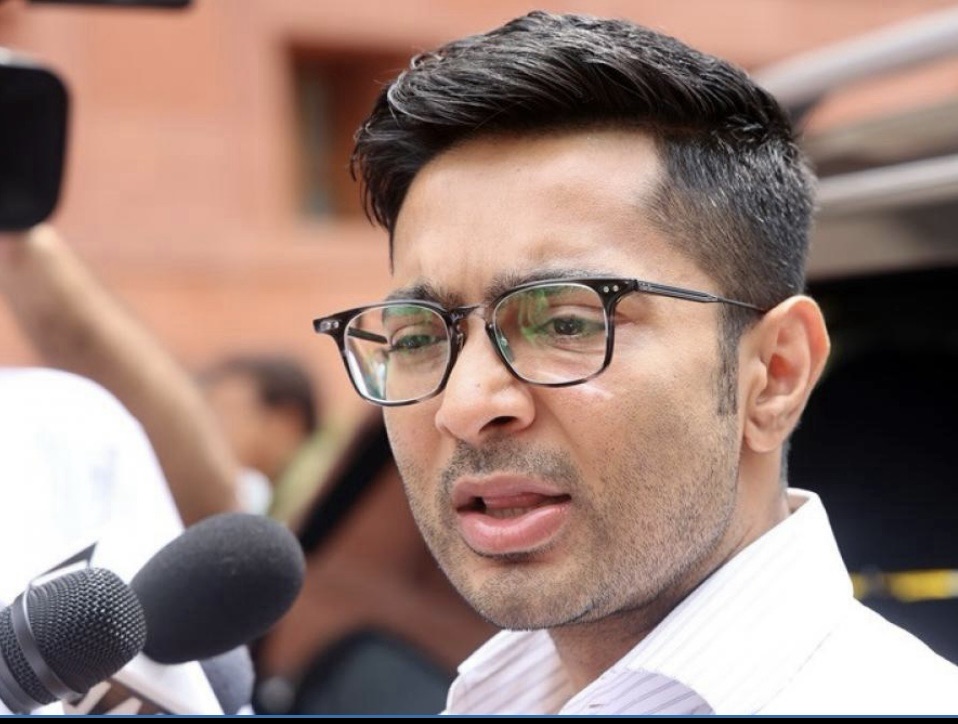
Abhishek Banerjee seeks judicial intervention after alleged attack on TMC office, calls it ‘open defiance of law’

KOLKATA: Political tensions in West Bengal escalated sharply on Thursday after Trinamool Congress national general secretary and Diamond Harbour MP Abhishek Banerjee alleged that armed men attacked and vandalised the party’s office on Camac Street in central Kolkata in the early hours of the morning. Describing the episode as a “disgraceful assault on the rule of law”, Banerjee demanded immediate arrests and urged the judiciary, particularly the Calcutta High Court, to take note of what he termed a serious breakdown of law and order.
According to Banerjee’s account, the incident took place at around 4.30am when a group of men allegedly entered the TMC office at 9 Camac Street. He claimed that the attackers assaulted people present inside, snatched mobile phones, damaged furniture and electronic equipment and ransacked the premises. The TMC leader subsequently shared videos and images on social media which purportedly showed damage inside the office and individuals wearing masks and helmets leaving the premises carrying electronic equipment.
The allegations have triggered another fierce political confrontation between the TMC and the BJP, coming at a particularly sensitive moment when the same Camac Street premises has already become the centre of a dispute involving the Kolkata Municipal Corporation, Kolkata Police and senior Trinamool leaders.
Banerjee accused BJP workers of being behind Thursday morning’s alleged attack, claiming that the men were armed and that the incident was not an isolated act of vandalism but part of a broader attempt at political intimidation. He questioned how such an incident could occur in the heart of Kolkata and alleged that police personnel did not respond for almost two hours despite repeated calls and emails from party workers and lawyers.
“What happened at Camac Street this morning is a disgraceful assault on the rule of law,” Banerjee said in a social media post, according to reports. He demanded the immediate arrest of everyone allegedly involved and called for an investigation into who planned, organised and directed the violence.
The TMC leader also widened his criticism beyond the police response, directly appealing to constitutional and judicial authorities. He questioned whether the West Bengal governor, the Union home minister and the Prime Minister’s Office would intervene, while urging the Calcutta High Court to take cognisance of the developments. His appeal for judicial intervention has added a legal dimension to what was already a rapidly escalating political dispute.
Banerjee also trained his guns on the BJP leadership in Bengal, alleging that the opposition was using “violence, vandalism and intimidation” against political opponents. He questioned Chief Minister Suvendu Adhikari over the alleged attack and demanded political accountability, arguing that an incident of this nature could not be reconciled with the functioning of a democratic system.
The BJP, however, has rejected the allegations. BJP leaders have described the accusations as politically motivated and denied that the party was responsible for the incident. West Bengal BJP president Samik Bhattacharya questioned the allegation of “vendetta politics”, arguing that if the BJP had intended to target TMC leaders after the recent political change in the state, the alleged campaign would have taken a very different form.
The latest confrontation assumes greater significance because the Camac Street office had already been at the heart of a bitter dispute over an allegedly unauthorised billboard. On August 27, a joint team of Kolkata Municipal Corporation officials and police went to the premises to remove the billboard. The operation resulted in a confrontation involving TMC leaders and police and civic officials.
That earlier confrontation led to multiple FIRs and arrests. Kolkata Police registered three cases in connection with the August 27 incident, with Abhishek Banerjee, Derek O’Brien and other TMC leaders named in the cases. Police alleged obstruction of government officials and other offences during the clash, while the Trinamool leadership maintained that the authorities had acted improperly. Thirteen people were initially arrested, with subsequent police action taking the number higher.
The billboard dispute also reached the Calcutta High Court. The TMC sought judicial intervention, including restoration of the billboard, but the court did not grant the immediate relief sought at that stage, observing that the plea was premature and required further consideration.
The legal controversy surrounding the premises has continued to deepen. The owner of the Camac Street property has separately asked the TMC to vacate the premises, alleging unauthorised occupation and pointing to issues concerning the lease arrangement. The matter has therefore evolved beyond a simple dispute over a billboard and now involves questions relating to property occupation, municipal enforcement, police action and political rights.
There have also been developments concerning the regulatory status of the building. Fire officials inspected the premises and identified alleged deficiencies, including issues concerning structural compliance and fire-safety certification. A subsequent notice reportedly warned of possible sealing if the deficiencies were not addressed. The authorities have maintained that such regulatory action falls within their normal enforcement responsibilities.
Against this backdrop, Thursday’s alleged attack has given the long-running Camac Street controversy a new and potentially more explosive dimension. For the TMC, the issue is now being projected as a question of political security and the rule of law. For the BJP, the allegations are being dismissed as an attempt to create a political narrative around a premises that has already been embroiled in several legal and administrative disputes.
Visual material released by the TMC has further intensified the controversy. Footage circulated after the alleged incident appeared to show masked or helmeted individuals carrying television screens, a printer and other objects out of the office. However, the identity and political affiliation of those individuals, as well as the precise circumstances surrounding the removal of the equipment, remain matters for investigation. Authorities had not, at the time of the latest reports, publicly established that the individuals shown in the footage were BJP workers.
The police response is likely to become one of the most closely watched aspects of the case. Banerjee has specifically questioned the alleged delay in police action, saying that repeated calls and emails were made before officers arrived. The TMC has consequently sought accountability not only for those allegedly responsible for the vandalism but also for the officials whose response is being questioned by the party.
The episode also comes just a day after TMC Rajya Sabha MP Derek O’Brien was questioned by Kolkata Police for several hours in connection with the earlier Camac Street confrontation. His questioning formed part of the investigation into the dispute surrounding the removal of the allegedly unauthorised billboard.
With two competing narratives now emerging, the immediate challenge for investigators will be to establish what actually happened inside the office, who entered the premises, whether property was deliberately damaged or removed, whether anyone was assaulted and whether the incident had any political connection. CCTV footage, eyewitness accounts and other available evidence are expected to play a crucial role in determining the sequence of events.
For Abhishek Banerjee and the TMC, however, the political message is already clear. The party is portraying the alleged attack as evidence that political confrontation in Bengal has crossed another line, with the TMC leader insisting that no political organisation or armed group can place itself above the law. His appeal to the judiciary indicates that the party intends to take the dispute beyond political accusations and seek institutional scrutiny.
The BJP, on the other hand, faces pressure to distance itself from any violence while challenging the TMC’s version of events. With the Camac Street premises already caught in a web of police cases, civic action and court proceedings, the latest allegations threaten to turn the office into an enduring flashpoint in Bengal’s increasingly combative political landscape.
What began with a dispute over a billboard has now widened into a much larger contest over political authority, policing and the limits of state power. As both sides sharpen their allegations, the spotlight is likely to remain firmly on the investigation — and on whether the evidence ultimately supports the competing claims being made by the two political camps.
Discover more from News Tap One
Subscribe to get the latest posts sent to your email.
