
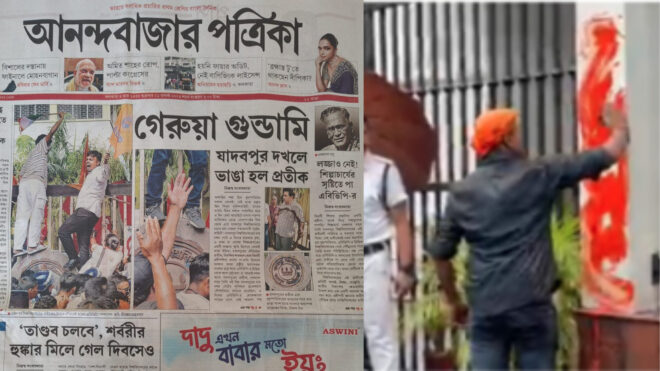
Saffron Paint, Angry Slogans: Protest Outside Anandabazar Raises Bigger Questions About Press Freedom
A protest outside the Anandabazar Patrika office in Kolkata on Tuesday has triggered a fresh debate over press freedom and political intolerance.
A group of saffron-clad men gathered outside the newspaper’s office on September 1 and protested against a recent report on the Jadavpur University clashes. The report used the phrase “Gerua gundami”, or “saffron hooliganism”, while describing the clashes.
The protesters raised slogans against Anandabazar Patrika and painted parts of the newspaper’s white building saffron. They also shouted that India would not tolerate an “insult” to the colour saffron.
The question, however is, does saffron belong to India, or does it belong to any particular political group?
Why should a newspaper face protests because someone disagrees with its choice of words? And can painting a media office really be considered a response to criticism?
The incident has also raised another important question: why is there growing intolerance towards criticism of political groups and those in power?
An FIR has already been registered against members of the Anandabazar Patrika editorial team, including two senior journalists, over the report. Journalists and media organisations have criticised the FIR and called for its withdrawal.
The controversy therefore goes beyond one newspaper report.
If the media is criticised every time it uses an uncomfortable word, can journalists really work freely?
If questioning a political group is treated as an attack on the nation, then what happens to freedom of expression?
And if every critic is called anti-national, who gets to decide what nationalism actually means?
Saffron is one of the colours of the Indian national flag.
But can the colour itself become a political shield against criticism?
Does painting a building saffron change anything on the ground?
A building can be painted in any colour, but that does not automatically mean development, progress or improvement. Real development is seen in jobs, education, healthcare, infrastructure, public safety and the quality of people’s lives.
The incident also raises questions about the political environment in West Bengal following the recent clashes and protests.
Where does political protest end and intimidation begin?
Can a democracy function if people become afraid to question those in power?
Is disagreement really anti-national? Or is the freedom to disagree one of the basic strengths of democracy?
The walls of the Anandabazar Patrika office were reportedly repainted to their original white colour a few hours after the protest.
But the larger issue remains.
The colour on the wall can be changed. But what about the growing debate over press freedom?
In a democracy, governments, political parties, journalists and citizens can all be criticised. The real test of democracy is not whether everyone agrees- it is whether people are allowed to disagree.
Discover more from News Tap One
Subscribe to get the latest posts sent to your email.

