
Companies Fleeing West Bengal? Claims, Counters & Questions | Analysis

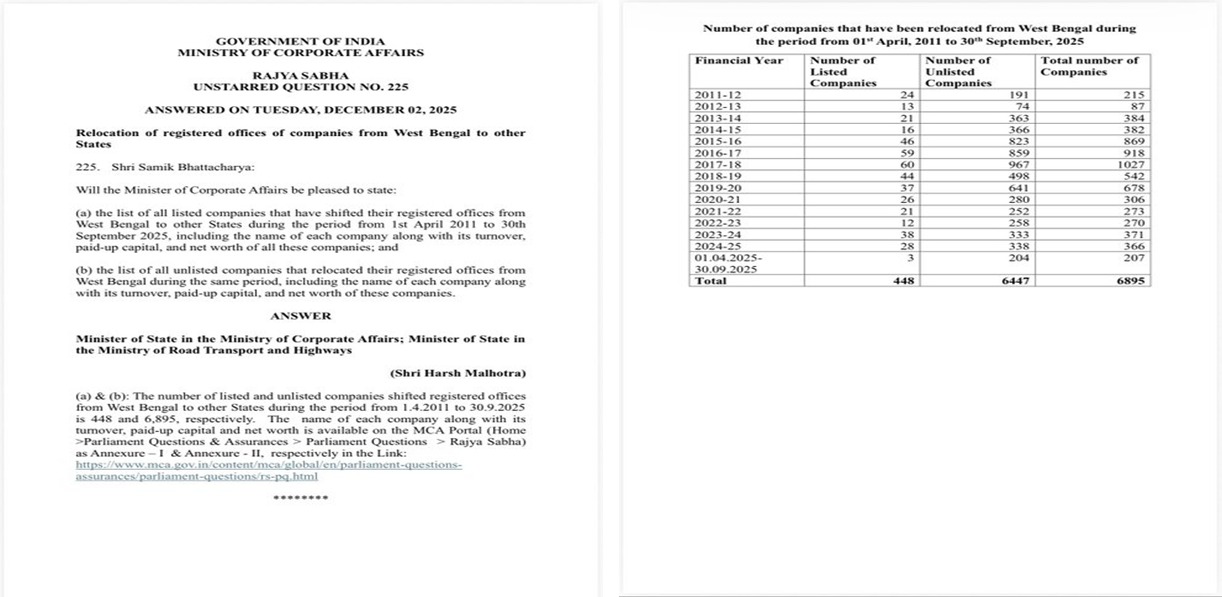
Kolkata, December 2025— The political storm over the alleged flight of companies from West Bengal intensified this week after a widely circulated post claimed that 6,895 companies have moved out of the state since Mamata Banerjee assumed power, including 207 companies in the last six months, citing figures submitted by the Ministry of Commerce. The allegation—first amplified through social media—argues that a mass exodus of firms has pushed the state 20 years backward, turning West Bengal into a no-go zone for industry.
But like the Bengali proverb: “jemon kane bashi, temon shone gaan” (you hear what you want to hear)—the interpretation of these numbers appears to depend on political lenses rather than absolute economic neutrality.
A published list claims that major listed companies such as Netweb Technologies, Gallant Ispat, Eureka Forbes, JK Tyre, Greenpanel Industries, and others shifted their registered office from West Bengal. The figure is numerically significant, and the flight of legacy brands raises questions about market confidence, taxation structures, legal predictability, and logistical competitiveness. Yet, a counter-fact posted in response argues that in the same 14-year period, 135,535 new companies were registered in West Bengal, challenging the narrative of unilateral economic decline. If thousands left but lakhs came—does this indicate collapse or transition?
The claims were led by political commentators criticising the state leadership, while responses highlight counter-statistics questioning selective data interpretation. The divide mirrors another Bengali proverb: “ghoti ar bati duye praman hoy na patil” — a pot cannot be judged by comparing a bowl and a mug. Economic health, similarly, cannot be measured only by exits without acknowledging entries.
But who verifies these claims?
Who audits whether a company moving its registered office equates to moving its physical operations, employment base, or production units?
Those questions remain unanswered. Some argue that the flight of companies is not a TMC-era problem alone. A response highlighted that business migration had been occurring since the days of the naxalite movement, hinting at multi-decade industrial stagnation. If economic decline began before the current administration, then is the present government the cause, or the inheritor of a deeper structural challenge? This echoes the folk wisdom: “purono gha notun byatha” — an old wound, new pain.
Do Kolkata Census Trends Reflect Job Stress or Structural Transition? — Critical Analysis

Complex picture of employment
The Census-based workforce profile of Kolkata Municipal Corporation presents a complex picture of employment, as seen in the above bar graph, that neither fully supports nor completely negates the claim of companies fleeing West Bengal. According to Census 2011, as seen in the below chart, 1,795,740 residents were engaged in work, of which 87.79% were in main work—a strong indicator of stable, long-term employment. However, the persistent gender disparity—383,274 female workers versus 1,412,466 males suggests that labour market participation remains uneven, hinting that industrial decline or service concentration may be disproportionately excluding women from economic activity.

The projected population increase to 6.57 million by 2025 without parallel visibility of job growth raises questions. If population grows faster than employment creation, the pressure on formal jobs becomes inevitable. Yet, Census data does not specify whether jobholders are in legacy manufacturing, informal retail, public sector roles, or digital services—meaning the dataset cannot directly prove that corporate exits are the primary cause of job strain.
Critically, 12.21% marginal employment reveals underemployment, a symptom that aligns with a transition economy—where informal work fills the gap as formal jobs stagnate. This may be interpreted by critics as indirect evidence of industrial erosion. However, proponents counter that Kolkata’s shift toward education, healthcare, IT, financial services, and creative sectors signals not collapse, but sectoral transformation.
Therefore, the Census neither conclusively validates nor disproves the “flight of companies” narrative; instead, it highlights a deeper structural question: Are jobs changing faster than the workforce can adapt? The original post claims that while other Indian states attract global capital, West Bengal lags behind. Gujarat, Maharashtra, Tamil Nadu, and Karnataka remain business magnets.
Why Are 6,895 Companies Leaving West Bengal? A Critical Review of Business Migration, Industrial Decline & New Business Registrations
The debate surrounding why are 6,895 companies leaving West Bengal continues to intensify, especially when critics argue that sustained business migration reflects a deeper industrial decline that has shaped the trajectory of the West Bengal economy over decades. Supporters of the government counter this claim by pointing to new business registrations, challenging whether the West Bengal economy is collapsing or undergoing restructuring. Still, the question persists—why are 6,895 companies leaving West Bengal despite a projected 10.5% GSDP growth and recent IT and manufacturing investments?
Critics argue that business migration is a long-term trend, citing data where industrial decline was visible even before the current administration. The West Bengal economy once contributed 10.5% to India’s GDP in the 1960s, falling to 5.6% by FY 2023-24, suggesting relative decline. While new business registrations continue, the capacity to replace large-scale manufacturing units remains uncertain, raising the question again—why are 6,895 companies leaving West Bengal when Infosys, Dhunseri Poly Films, and NTT Data Centers are entering the state?
Supporters argue that new business registrations and strategic projects like the 200-acre Silicon Valley hub indicate transition rather than industrial decline. However, analysts note that Indian states attract global capital, West Bengal lags behind, as Gujarat, Maharashtra, Tamil Nadu, and Karnataka remain business magnets due to land reforms, faster clearances, and strong logistics corridors. This strengthens the perception of business migration away from Bengal, despite positive announcements.
Ultimately, the contradiction between new business registrations and industrial decline continues to define the West Bengal economy, leaving policymakers and economists divided over why are 6,895 companies leaving West Bengal — a question that will influence future investment confidence.
However, the Maharashtra government’s launch of the MATRIX (Maharashtra Technology, Research Incubator and Xcelerator) programme signals a decisive shift in its ambition to become a national innovation powerhouse. The initiative plans the establishment of 200 incubation centres, supporting startups across AI, quantum computing, robotics, VR/AR, blockchain, cybersecurity, big data, and IoT. The programme targets 10,000 startups, ₹1 lakh crore in projected revenue, and 100,000 new jobs, positioning the state as a next-generation Maha-Hub of deep-tech entrepreneurship.
Running parallel is the Maharashtra Global Capability Centre (GCC Policy 2025)—a complementary strategy designed to attract 400 new Global Capability Centers, create 400,000 high-skilled jobs, and reposition Maharashtra as the leading hub for IT services, fintech, R&D, digital engineering, and global operations. The Maharashtra GCC Policy PDF outlines non-fiscal incentives such as industry status to GCCs, 24/7 operational flexibility, assured utility supply, land priority, and the ability to operate in residential and no-development zones, marking a significant ease-of-business commitment.
The policy further decentralizes investment beyond Mumbai and Pune by building GCC ecosystems in Nagpur, Nashik, Aurangabad, and Kolhapur, while the MATRIX incubation grid nurtures startups from ideation to commercialization. Skill development remains pivotal—the government plans to collaborate with universities to build GCC-ready talent skilled in digital, analytics, and domain-specific capabilities, as stated in the Maharashtra Global Capability Centre Policy 2025 PDF.
Together, MATRIX and the Maharashtra GCC Policy 2025 showcase a synchronized strategy—not merely to attract global firms but to anchor startups, research, and value-chain integration within the state, reshaping Maharashtra into India’s emerging innovation command centre.
The Tamil Nadu Global Investors Meet 2024 opened at the Chennai venue with large-scale participation promoted through Guidance Tamil Nadu Twitter and the Tamil Nadu Investors Association, both as the government aims to strengthen global perception ahead of its trillion-dollar economic target. The meet raises key public questions shaping policy discourse: What is the theme of Tamil Nadu Global Investors Meet 2025? How many global investors meet in Tamil Nadu annually? and What is the investment promotion program in Tamil Nadu that ensures commitments convert into operational assets?
Tamil Nadu highlights its Top 10 investors, spanning EVs, electronics, and renewable energy, reflecting a shift from traditional manufacturing to advanced sector portfolios. The State’s tourism policy also featured prominently as part of broader economic positioning.
However, comparisons persist with Karnataka — Bengaluru draws investors through startup depth, tech capital, and GCC dominance without large-scale events. Analysts note that Tamil Nadu’s strategy emphasizes planned industrial corridors, while Karnataka’s growth appears ecosystem-led.
The long-term question is whether MoUs evolve into measurable economic outcomes. But cost advantages, tax breaks, port access, land acquisition ease, and political stability differ by state. Still, critics might ask:
If West Bengal is losing companies but gaining over 135,000 new registrations, are these firms serving new economic sectors—like fintech, services, logistics, or tech startups—rather than legacy manufacturing?
Is West Bengal shifting economic identity rather than losing it?
The allegation warns that Bengal is bleeding jobs and losing investment. Departures of legacy manufacturing could mean:
- Reduced blue-collar jobs
- Slower export growth
- Loss of economic prestige
But skeptics counter—large company registrations do not automatically assure employment either. Many new companies are micro or digital-first entities. This prompts the key policy puzzle—
Is West Bengal bleeding traditional labour-intensive industries while gaining smaller, service-oriented ones?
If so, who benefits and who becomes economically invisible?
The narrative raises difficult questions.
Who interprets the migration of companies—politicians, economists, or the people who lose or gain employment?
- If 6,895 departures mirror decline, they must be examined seriously.
- If 135,535 registrations reflect growth, they should be acknowledged objectively.
Policy must be based on clarity—not celebration or condemnation.
Three Facts That Complicate the Debate
1️⃣ Company registration does not guarantee operational presence—many register in metro cities for investor access but manufacture elsewhere.
2️⃣ Registered office migration may reflect compliance convenience—not economic abandonment.
3️⃣ New companies may employ fewer people digitally, while older companies leaving may have left a larger employment void.
Therefore, the question remains:
Are we counting signatures on paper or hands on machines?
Bengali proverbs teach resilience— “osomoye brishti, krishoker mukhe hasi ane na” — untimely rain does not make the farmer smile.
Similarly, numbers without context do not make the citizen confident. If the state is losing legacy giants but gaining a new entrepreneurial class, the future depends on whether:
- Policy catches up,
- Infrastructure modernises,
and
- Confidence returns.
The opposing statistics show that West Bengal’s economic story may not be a simple headline—but an unfinished chapter.
Is Bengal declining?
Or reinventing itself?
For now—like another timeless proverb— Time will prove whose path was right.

