
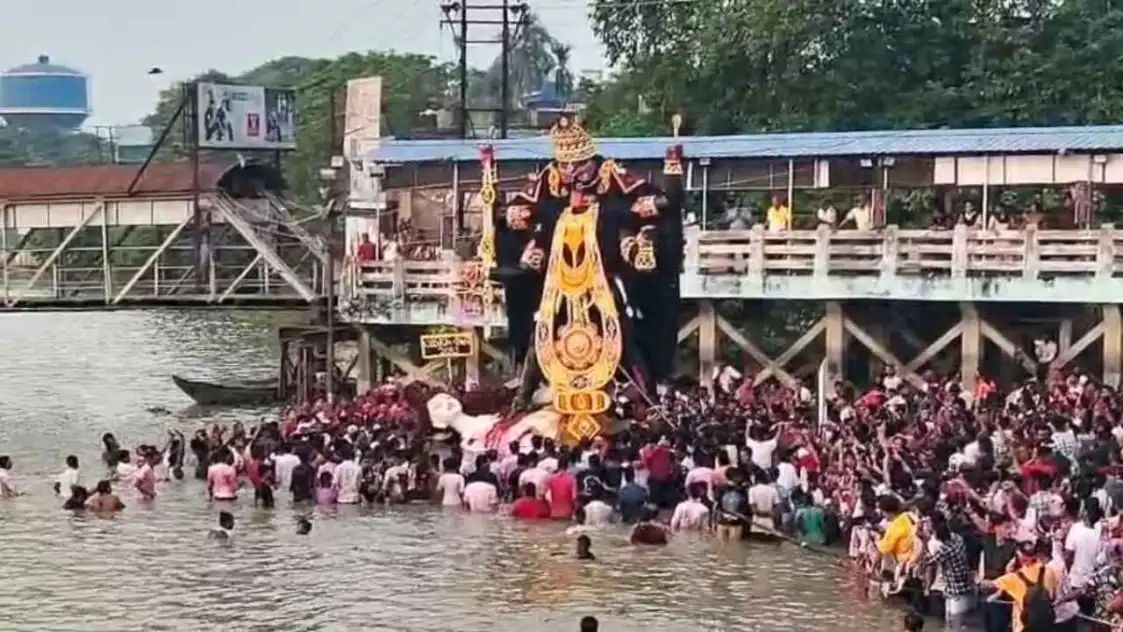
Naihati Boro Maa Immersion Draws Massive Crowds, Security Tightened
Naihati, November 13, 2026: Thousands of devotees thronged Aravinda Road in Naihati on Thursday as Boro Maa began her journey towards immersion, marking the end of the 103-year-old Kali Puja tradition. The grand farewell was accompanied by elaborate security arrangements, with drones, giant LED screens and additional police personnel deployed to manage the massive gathering.
The immersion procession took place on November 12 following special rituals and the traditional farewell ceremony. Before the procession began, the Goddess’s gold and silver ornaments were removed and she was adorned with floral jewellery. However, her distinctive golden eyes remained in place during the immersion, continuing a unique tradition associated with Naihati’s Boro Maa.
The scale of the gathering prompted the Barrackpore Police Commissionerate to introduce extensive crowd-management measures. Drone surveillance was deployed to monitor the procession and surrounding areas, while giant LED screens were installed at several important junctions so that devotees unable to reach the immediate procession route could watch the immersion.
The administration also increased the number of volunteers accompanying the procession to 300 following discussions between the police and the temple committee. Additional police personnel, including senior officers, were stationed along Aravinda Road and near the Ganga ghat to ensure that the proceedings remained orderly.
In view of safety concerns, the police prohibited devotees from throwing flowers and batashas from rooftops and balconies along the procession route. Traffic restrictions were imposed on important roads from noon, while ferry services between Naihati and Chinsurah remained suspended from 11 am to 5 pm.
The procession was scheduled to begin between 3.30 pm and 4 pm, with the idol transported on a specially designed wheeled trolley towards the Ganga ghat near Naihati ferry terminal. A helicopter flower-showering arrangement had also been planned as an additional attraction, although the plan was eventually cancelled.
After the immersion of Boro Maa, the other Kali idols in Naihati were scheduled to follow the traditional sequence of immersion. The practice of immersing Boro Maa before the other local Kali idols remains an important part of the town’s annual celebrations.
For Naihati, Boro Maa’s immersion is much more than the conclusion of a religious festival. The annual gathering reflects a deep connection between the Goddess and the people who travel from different parts of Bengal to seek her blessings. As the celebrations come to an end, devotees return home carrying the familiar promise of another year’s wait, hoping to welcome Boro Maa again next Kali Puja.
But perhaps the most remarkable part of Boro Maa’s farewell is not the scale of the procession, the elaborate arrangements or the thousands who gather along Aravinda Road. It is the emotion that brings them all together. For many devotees, the annual journey is deeply personal – a tradition passed down through generations, a promise to return and an expression of faith that goes beyond the boundaries of Naihati.
In an age when celebrations are increasingly defined by grand spectacles and social media moments, Boro Maa’s 103-year-old tradition offers something more enduring. The sight of people waiting for hours, balconies packed with devotees and families following the procession reflects how deeply religious traditions can become woven into a community’s identity. The drones and LED screens may be new, but the devotion they help accommodate is generations old.
And perhaps that is what makes Boro Maa’s immersion so extraordinary. The Goddess leaves the town, but the anticipation of her return begins almost immediately. For those who stood along Aravinda Road, watched from their rooftops or followed her final journey to the Ganga, the farewell is never quite an ending. It is simply a promise to return.
Perhaps this is what makes Bengal and its festivals so special. Here, celebrations often become bigger than religion, rituals or individual beliefs. They become a shared cultural experience where people from different communities, backgrounds and walks of life stand shoulder to shoulder, united by the joy of being part of something familiar. Whether it is Durga Puja, Kali Puja, Eid, Christmas or Poila Boishakh, Bengal has a way of turning festivals into occasions of collective belonging. Boro Maa’s farewell is another reflection of that spirit — where devotion may bring some people together, but culture, nostalgia, emotion and a sense of belonging bring everyone along. In Bengal, the celebrations are not always about what separates us; they are often about everything we share.
Discover more from News Tap One
Subscribe to get the latest posts sent to your email.

