
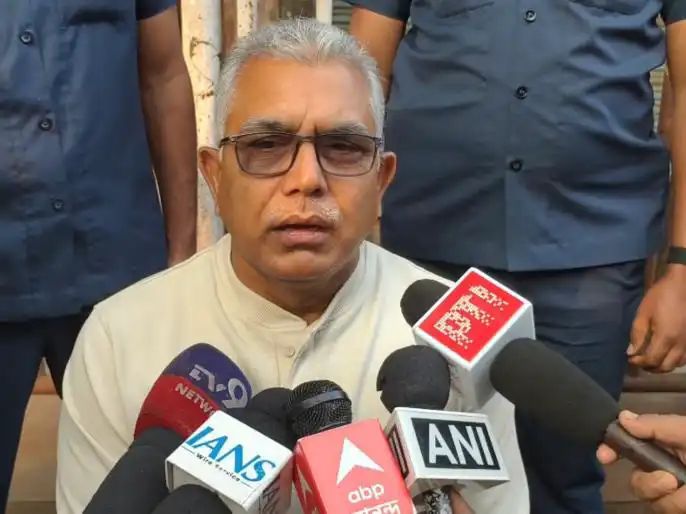
Whole World Has a Complaint Against You’: Dilip Ghosh Targets Abhishek Banerjee

Kolkata, November 15, 2026: West Bengal Minister Dilip Ghosh has taken a dig at Trinamool Congress (TMC) MP Abhishek Banerjee over his recent appearance before Kolkata Police, remarking that the police were now acting on complaints filed against him. Ghosh’s comments have added another chapter to the ongoing political confrontation between the BJP-led state government and the opposition TMC.
Speaking to reporters in Kharagpur on Sunday, Ghosh dismissed allegations that the police were functioning as an instrument of the BJP. Referring to Banerjee’s appearance before the police, he said, “The police used to listen to them back when they were in power. Today, the police are taking action on the complaint filed against him.”
Responding to questions about allegations of political interference in police functioning, Ghosh added, “So the police have become the BJP’s? Police is police. If you have a complaint against anyone, just file it. Whereas the whole world has a complaint against you.” His remarks were directed at Banerjee amid the latter’s ongoing legal engagements with Kolkata Police.
Banerjee appeared at Bhawanipore Police Station on Saturday, November 14, in connection with an FIR registered over a social media post published on May 2. The post targeted Chief Election Commissioner Gyanesh Kumar and referred to a “Gujarati gang”. A complaint was subsequently lodged by a Bhawanipore resident, alleging that the remarks could promote enmity and disturb communal harmony. Police registered a case on May 27, and Banerjee was questioned for nearly four hours.
After leaving the police station, the TMC national general secretary maintained that he had nothing to hide and had always cooperated with investigating agencies whenever summoned. He also rejected the allegations against him, describing the police action as an attempt to intimidate him. Banerjee asserted that he would continue to appear whenever called by the authorities but would not be intimidated by notices or investigations.
The matter does not end with Saturday’s questioning. Kolkata Police have issued another summons asking Banerjee to appear before the investigating officer at Girish Park Police Station on November 20. This notice relates to a separate FIR registered on October 31 over alleged threatening remarks against police personnel and allegations of obstructing officers from performing their duties. The complaint stems from remarks Banerjee reportedly made on October 29, accusing certain police officers of targeting TMC workers.
The latest developments have unfolded amid another political dispute following the demolition of a makeshift structure outside Banerjee’s Kalighat residence on November 12. The Kolkata Municipal Corporation stated that the structure, located on a footpath, was obstructing pedestrian movement. Banerjee, however, claimed that the demolished structure had been used by police personnel and urged the authorities not to target people earning their livelihood in the area.
The exchange between Ghosh and Banerjee reflects the increasingly confrontational relationship between the ruling BJP and the TMC following the change of government in West Bengal. While the BJP maintains that complaints against political leaders must be investigated like those against any other citizen, the TMC has alleged that police notices and investigations are being used to target its leadership.
Beyond the political sparring, the developments bring an important institutional question into focus: can law enforcement maintain public confidence when investigations involving prominent political figures become part of an ongoing political battle? The right to question, investigate and seek accountability must apply equally, irrespective of political position. Equally, those facing allegations must have the opportunity to defend themselves through due process. Ultimately, the credibility of the police will depend not on which political camp welcomes its actions, but on whether every investigation is conducted fairly, transparently and without favour.
As citizens, it is worth asking ourselves how much of our political understanding is shaped by facts and how much by the rivalries playing out between parties. When a leader is summoned by the police, do we first ask what the complaint is about, what evidence exists and whether due process is being followed, or do we immediately view the development as a victory or defeat for a political camp? Perhaps we need to look beyond the personalities involved and examine the institutions and procedures at the centre of these controversies.
There is also a responsibility on the audience to distinguish between an allegation, a political statement and an established fact. A police summons does not establish guilt, just as a political accusation does not automatically establish victimisation. In an age when provocative statements and partisan reactions travel faster than verified information, how often do we pause to understand the actual sequence of events before forming an opinion?
Ultimately, democracy is not merely about choosing who governs; it is also about questioning those who govern, demanding accountability and protecting institutions from political influence. The question we should carry forward is simple: are we becoming more interested in who scores points against whom, or are we paying enough attention to whether justice, fairness and accountability are being upheld?
Discover more from News Tap One
Subscribe to get the latest posts sent to your email.

