
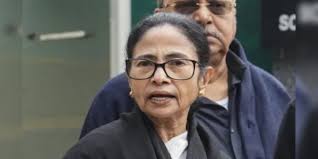
Mamata Banerjee Steps Into the Supreme Court Arena, Turning the Courtroom Into a Political Chessboard
West Bengal Chief Minister Mamata Banerjee appeared personally before the Supreme Court of India on February 4, 2026, challenging the Special Intensive Revision (SIR) of electoral rolls in the state by the Election Commission. It was something extraordinary–a sitting captain going out of the pavilion to referee herself. When Banerjee, a law graduate and hardened political street-fighter, presented her own case as a party-in-person to the apex court, Banerjee was the first serving Chief Minister to do so herself, and made a legal hearing a symbolic struggle over democracy itself. Her central argument in this plea was that the SIR exercise was more about pruning instead of cleaning electoral rolls.
Banerjee asserted that almost 1.4 crore voters stood to lose because they made what she termed as logical differences, the slight spellings changes, change of initials or surname after marriage. In her analogy-based reasoning, she compared the action to one of employing a bulldozer in place of a toothbrush, she cautioned that excess will disenfranchise millions of people, especially the poor and the marginalised, without their knowledge. Banerjee also wondered why the exercise was selective and questioned why West Bengal was the state to undergo such an intensive revision and not states such as Assam. This according to her was like refereeing one team and letting the rest play without any referee. Her most stinging comment was when she termed the Election Commission of India a WhatsApp Commission because it was using informal and opaque channels of communication rather than going through constitutional process of doing things.
She also argued that the EC denied Aadhaar the mandate to be used as an authentic document to resolve discrepancies further creating anxiety among the voters. The reaction of the Supreme Court was an indication that Banerjee was a chord-striking writer. A bench headed by Surya Kant gave a notice to the Election Commission, and warned it to be more circumspect and alert especially in issuance of notices to high profile citizens or in situations where a small discrepancy in names was discovered. The tone of the Court was cool, but stern–not a decision, a yellow card in a hot game politics. This case is set to be reheard again on February 9, 2026, when Banerjee will presumably be reappearing in court, which is an indication that this fight is not yet complete. Running on par with this electoral controversy are other legal flashpoints in the Chief Minister. The Supreme Court is also taking a plea in which the Enforcement Directorate has accused Banerjee and the state police of hindering ED raids at the office of political consultancy I-PAC.
In a similar smuggling of coal investigation, the Court in January 2026 blocked FIRs initiated by the Bengal government against the ED officials, warning of a slip into anarchy. Collectively, these examples seem like a political chess board of high stakes: voter roll, federal agencies, and constitutional authority coming all at the same time. Mamata Banerjee went beyond making a point of law by going into court herself: she indicated that to her, the defence of the vote is not merely administrative but existential. This action will redefine the electoral jurisprudence or significantly sharpen the political fault lines, which will become evident when the Court reconvenes next week.

