
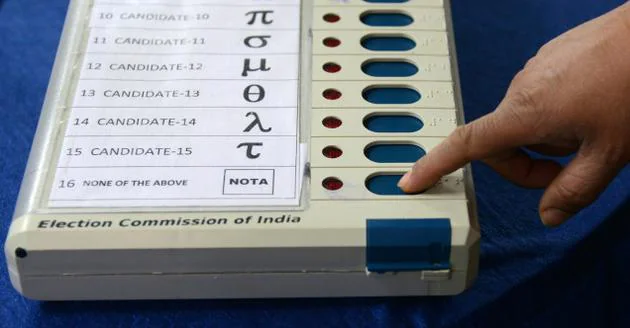
NOTA: A voter’s way to reject flawed political choices

“None of the Above” (or NOTA) has been provided as an option to the voters of India in most elections since 2009. The vote does not hold any electoral value: even if a majority of votes are cast the candidate with the largest vote share would be declared the winner. By expressing a preference for none of the above, a citizen can choose not to vote for any candidates who are contesting the elections. It was a landmark 2013 Supreme Court judgment—the People’s Union for Civil Liberties v. Union of India case—which paved the way for the introduction of NOTA. Since its inception in 2013, the polling figures for NOTA have remained minimal. The 2015 Assembly elections in Bihar saw 2.49% of the votes polled under NOTA, which is the highest share so far in any Assembly elections since its inception
One of the most notable aspects of the recently concluded Gujarat Assembly elections was the fact that more than 5.5 lakh voters (1.8% of all votes cast) selected the None of the Above (NOTA) option to voice their opposition to all candidates running for office. According to The Hindu, NOTA votes played a significant role in deciding the results of roughly 24 constituencies. In other words, the margin of victory in around two dozen constituencies was lower than the NOTA votes. 3,050 NOTA votes were cast in Godhra, where the BJP ousted the Congress for the first time in 15 years, however, the winner was only elected by 258 votes. Going by these figures, it looks like the Indian voter isn’t that cynical after all. Having said that, it has only been four years since the introduction of NOTA, and the arguments against its validity present a rather narrow vision of what democracy entails.
Voting is a formal way to express one’s opinion or will during an election. The right to reject suggests that a voter has the absolute right to cast their ballot and not select any of the candidates. Such a right suggests a decision to stay impartial. This could occur if a voter believes that none of the contenders in a race deserves to win. It occurs as a result of his decision, conviction, thought, and expression. According to the Association of Democratic changes, a non-profit organization working on political and electoral changes, “right to reject has its roots in freedom of speech and expression.
The ADR says that by the implementation of NOTA, the political parties will realise that a large number of people are expressing their disapproval of the candidates being put up by them, there will gradually be a systemic change, and the political parties will be forced to accept the will of the people and field candidates who are known for their integrity, this statement is backed by The Election Commission as well.
Several patterns can be seen based on this analysis of NOTA voting trends that was published in The Hindu:
1) There were more NOTA votes cast in the areas designated for SC and ST.
2) Areas impacted by left-wing extremism are performing better in NOTA voting.
3) NOTA votes are comparatively higher in districts where the Congress and the Bharatiya Janata Party are locked in a head-to-head contest.
However, the NOTA will be completely useless if the Election Commission has not yet established any guidelines for its legal standing if it defeats the candidate with the most votes. The Representation of Peoples Act does not contain any regulations that specify what will happen if NOTA receives a majority of votes. Even T S Krishnamurthy, a former chief election commissioner, is in favor of the concept. In an interview with the Times of India, he declared: “There should be a second round of elections with new candidates if NOTA votes are more than the votes polled for any candidate. It teaches political parties the importance of nominating candidates based solely on merit and not caste, creed, or language without the need for legislative sanctions. Although it is unknown whether political parties will implement this particular suggestion, setting up such rules would undoubtedly provide better incentives for voters to use their NOTA vote.
Discover more from News Tap One
Subscribe to get the latest posts sent to your email.

